Table of Contents
- 1. What happens during the initial consultation and requirements gathering for electric gate installation?
- 2. How is a site survey and technical assessment conducted before installing electric gates?
- 3. How do you select the right gate type and design for your property?
- 4. When is planning permission and legal compliance required for electric gate installations?
- 5. What civil engineering and groundwork preparation is needed for electric gates?
- 6. How are electric gates fabricated and manufactured to match specifications?
- 7. How is the motor and power system installed for electric gates?
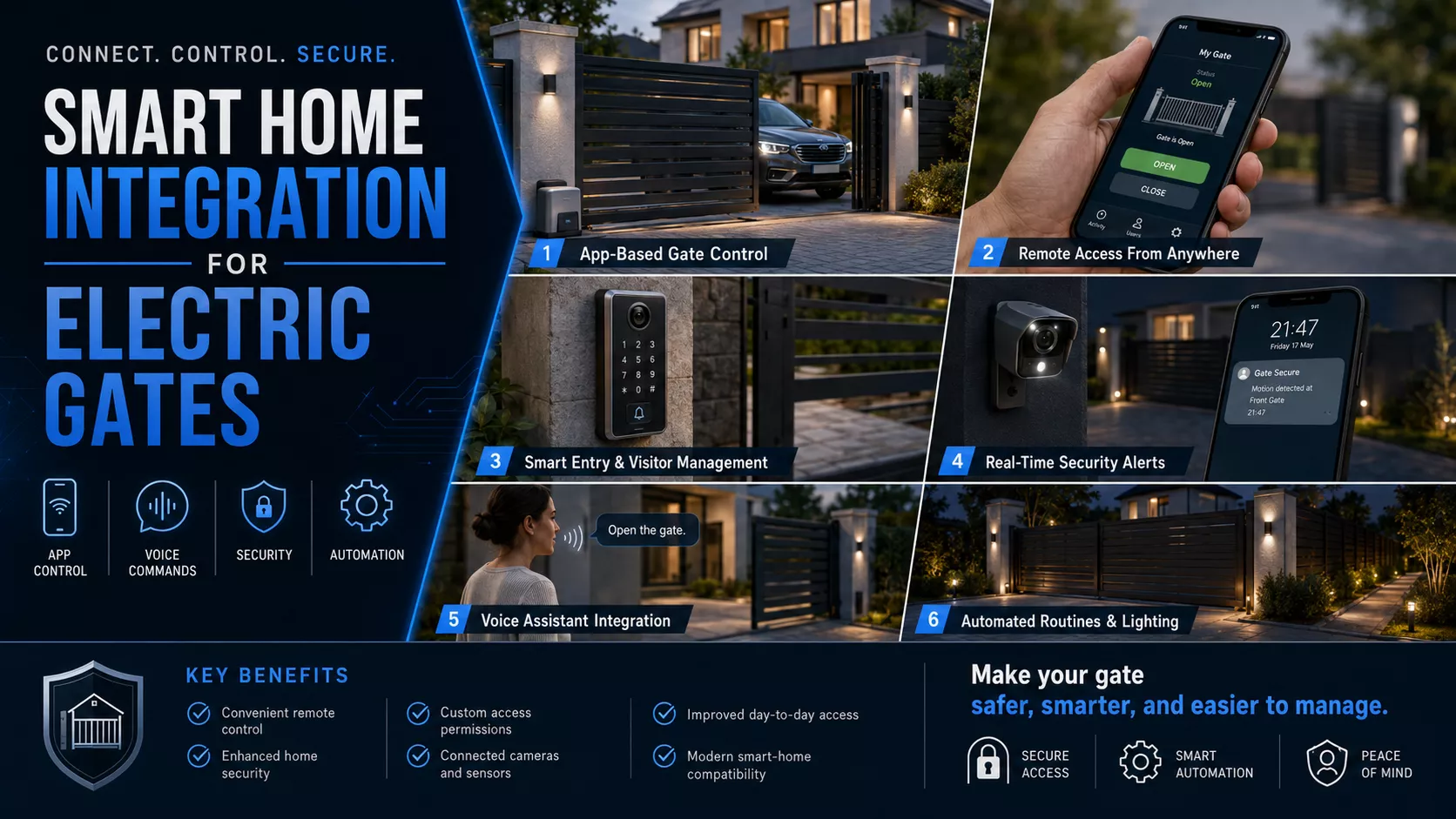
- 8. How is the access control system integrated into electric gate automation?
- 9. How are safety systems set up to ensure compliance and user protection?
- 10. What testing and compliance checks are required after electric gate installation?
- 11. How is post-installation maintenance planned for electric gate longevity?
- 12. Frequently Asked Questions
What happens during the initial consultation and requirements gathering for electric gate installation?
The initial consultation defines the foundation for electric gate installation. The installer conducts a site survey to examine physical dimensions, access points, terrain gradients, and environmental factors. These attributes influence gate type, size, and automation system selection.
The installer gathers customer requirements, including operational preferences, security levels, entry control methods, and design aesthetics. Customers may request features such as remote access, intercom systems, or smartphone integration. Every preference aligns with safety standards and regulatory compliance.
Power supply assessment is critical. Technicians evaluate existing electrical infrastructure, determine voltage availability, and calculate load requirements. Some locations may require dedicated circuits or upgrades to accommodate motorised systems.
Safety considerations govern the design. The installer identifies potential hazards, such as pinch points, entrapment risks, and pedestrian access conflicts. Compliance with standards like BS EN 12453 ensures protective measures, including safety edges, photocells, and emergency stops, are incorporated.
This phase establishes a clear scope, technical specifications, and client expectations. Detailed documentation produced here informs accurate quotations, project timelines, and legal obligations. The requirements gathering process mitigates risks and ensures the installed system performs reliably, safely, and in full alignment with user needs.
How is a site survey and technical assessment conducted before installing electric gates?
A thorough site survey anchors the electric gate installation process. Technicians perform structured evaluations across multiple areas:
- Layout & Dimensions: Measure driveway width, assess clearance zones, and locate obstacles (trees, walls, utilities) affecting gate type selection (swing, sliding, cantilever).
- Ground Conditions: Analyse soil type, stability, drainage patterns, and load-bearing capacity. Problematic conditions (clay, waterlogging, gradients) demand reinforced foundations.
- Power Supply: Inspect existing electrical infrastructure, verify voltage availability, and calculate system power requirements. Upgrades may be essential for motor and control unit reliability.
- Safety Evaluation: Identify hazards like slopes, pedestrian pathways, and nearby traffic. Ensure compliance with BS EN 12453 through safety edges, sensors, and manual overrides.
- Planning Permission: Check local council regulations on gate height, placement, and appearance to ensure legal compliance.
The technical assessment follows:
- Gate Type & Design: Recommend optimal gate configuration based on site data and client preferences.
- Material Selection: Choose materials suited for durability, aesthetics, and environmental resilience.
- Automation System: Specify motor types, control panels, obstacle sensors, emergency stops, and locking systems.
- Installation Preparation: Plan groundwork, levelling, drainage solutions, and wiring pathways for smooth operation.
- Risk Assessment: Conduct a comprehensive hazard analysis to safeguard future operations.
How do you select the right gate type and design for your property?
Gate type selection determines operational mechanics, space utilisation, and user convenience. Installers analyse driveway dimensions, slope gradients, obstruction points, and clearance zones to select the optimal gate system.
- Swing Gates operate on hinges, opening inward or outward. They require unobstructed flat ground with sufficient arc space.
- Sliding Gates move laterally on ground tracks. They suit narrow or sloped driveways with limited frontal clearance.
- Bi-folding Gates fold centrally, reducing swing space. They serve wide openings where depth is restricted.
- Cantilever Gates glide on suspended rails, eliminating the need for ground tracks. They excel on uneven, debris-covered, or frost-prone surfaces.
- Telescopic Gates compress multiple panels into compact sections. They optimise tight lateral spaces.
- Overhead Gates lift vertically, mimicking garage doors, ideal for driveways lacking horizontal clearance.
Design selection defines material durability, aesthetic integration, and security performance.
- Steel ensures structural strength for high-security installations.
- Aluminium resists corrosion in coastal or humid climates.
- Wood complements traditional or natural landscapes.
Security features include access control systems (keypads, proximity readers, remote transmitters), CCTV integration, safety sensors, and automatic locking mechanisms. These attributes enhance safety compliance and user control.
When is planning permission and legal compliance required for electric gate installations?
Planning permission regulates electric gate installations to ensure legal conformity and protect local environments. Installers evaluate multiple legal attributes before proceeding.
Factor | Requirement | Regulatory Body / Standard |
Gate Height | Over 1 metre near highways or 2 metres elsewhere requires permission | Local Planning Authority |
Gate Location | Adjacent to public roads, footpaths, or property boundaries may need approval | Local Planning Authority |
Sensitive Areas | Conservation areas, listed buildings require formal consent | Historic England, Local Authority |
Heritage Impact | Alterations on listed properties need Listed Building Consent | Listed Building Consent Process |
Safety Compliance | Mandatory obstacle detection, safety sensors, and emergency stops | BS EN 12453, Building Act 1984 |
Planning Legislation | Governs domestic gate installations | Town and Country Planning Act 1990 |
Legal documentation involves preparing site plans, elevation diagrams, neighbour consultations, and compliance reports. Installers frequently liaise with councils to streamline approvals and meet all legal obligations.
Non-compliance may lead to enforcement actions, fines, or mandatory gate removal. Full legal preparation ensures smooth installation, future safety, and regulatory protection.
What civil engineering and groundwork preparation is needed for electric gates?
Civil engineering and groundwork preparation establish the structural integrity for electric gate installation. This phase addresses physical stability, load distribution, and infrastructure routing.
- Site assessment identifies soil composition, load-bearing capacity, and drainage characteristics. Clay soils, loose gravel, or high water tables may demand reinforced foundations.
- Ground levelling ensures even surfaces for gate alignment. Uneven terrain is graded to prevent operational stress on motors and mechanical components.
- Foundation work creates stable anchoring points for gate posts and support structures. Deep-set concrete footings resist shifting due to weather or soil movement.
- Drainage systems prevent water accumulation that could compromise foundations or affect electrical components. Perforated piping and proper slope gradients divert water efficiently.
- Cabling infrastructure integrates power lines, control wiring, and communication cables. Ducting systems protect cables from moisture, physical damage, and future maintenance disruption.
- Conduit positioning defines cable routing paths, keeping electrical and data lines separated for safety and signal integrity.
Correct groundwork eliminates misalignment, gate sagging, or premature mechanical wear. Precision in this stage guarantees smooth operation, long-term reliability, and safety compliance.
How are electric gates fabricated and manufactured to match specifications?
Gate fabrication converts detailed designs into robust, functional structures, combining engineering precision with aesthetic craftsmanship. Each step directly influences long-term performance, safety, and appearance.
Process | Description | Purpose |
Material Selection | Steel, aluminium, timber based on environmental exposure and design requirements | Strength, corrosion resistance, visual harmony |
Cutting & Shaping | Laser cutting, plasma cutting, CNC machining | Precision in dimensions and complex design accuracy |
Welding & Assembly | MIG, TIG welding methods | Structural integrity and load-bearing capacity |
Surface Treatment | Galvanisation, powder coating, painting | Corrosion protection, UV resistance, aesthetic finish |
Feature Integration | Hinge brackets, automation mounts, sensor fittings | Compatibility with automation and safety systems |
Dimensional Accuracy | Exact measurements aligned with site groundwork | Prevents misalignment and mechanical stress |
Quality Control | Weld inspections, tolerance checks, surface assessments | Compliance with British Standards, operational reliability |
Accurate fabrication ensures the gate operates smoothly under automation stress and environmental conditions. Any deviation during manufacturing can lead to safety issues, mechanical failures, or costly adjustments post-installation.

Electric Gates Crafted and Manufactured to Specification
How is the motor and power system installed for electric gates?
Motor and power installation enable automated gate operation by combining precise mechanical mounting with compliant electrical integration. Each step ensures reliable performance, safety, and longevity.
Task | Description | Purpose |
Motor Mounting | Position motor per manufacturer’s guidelines with stable clearance | Prevents operational obstruction and mechanical stress |
Secure Fixing | Bolt motor to base or bracket; apply chemical sealant where necessary | Ensures stability under repetitive load cycles |
Alignment | Align motor drive with gate movement axis | Reduces friction, wear, and potential misalignment failures |
Power Source Connection | Locate power supply (often via transformer or dedicated circuit) | Provides stable, regulated electrical current |
Cable Routing | Route cables through protective conduits | Shields wiring from moisture, pests, and physical damage |
Electrical Connections | Follow wiring diagrams using wire nuts or crimp connectors | Guarantees durable, safe, and compliant electrical links |
Grounding & Insulation | Apply proper earthing and insulation methods | Prevents electrical hazards and ensures user safety |
Safety Compliance | Adhere to IET Wiring Regulations (BS 7671) | Meets national electrical safety standards |
Precise motor and power installation prevents breakdowns, electrical faults, and safety incidents. Poor execution risks motor strain, overheating, or system failures.
How is the access control system integrated into electric gate automation?
Access control system integration enhances electric gate functionality by regulating authorised entry and boosting security. This stage combines hardware installation with electronic programming to ensure safe and efficient operation.
Process | Description | Purpose |
System Selection | Choose keypads, intercoms, proximity readers, or biometric scanners based on security level and user convenience | Tailors system to user needs and threat levels |
Site Preparation | Position control devices for driver or pedestrian access, ensuring visibility and weather protection | Guarantees ease of use and protection against environmental damage |
Hardware Installation | Mount access panels, reader posts, and control cabinets | Provides stable, secure physical structures for control units |
Wiring & Connectivity | Route power and data cables through protected conduits | Ensures signal integrity, prevents damage, and simplifies maintenance |
Security Features Integration | Link CCTV, intrusion alarms, and remote monitoring | Provides layered security and incident response capability |
Programming & Configuration | Set user permissions, access codes, and scheduling rules | Controls access privileges and operational timings |
Testing & Validation | Verify system response, fail-safes, and backup functions | Confirms full functionality, reliability, and safety compliance |
Proper integration delivers secure, efficient, and user-friendly gate operation. Inadequate configuration risks security breaches or operational failures.
How are safety systems set up to ensure compliance and user protection?
Safety systems setup ensures the electric gate operates within legal safety standards while protecting users from injury and property from damage. This phase integrates hardware, performs compliance tests, and calibrates safety mechanisms.
Process | Description | Purpose |
Risk Assessment | Identify potential hazards: entrapment points, crushing zones, and collision risks | Determines necessary safety measures and compliance needs |
Force Testing | Measure gate opening/closing force using calibrated meters | Ensures force remains within safe operational limits defined by BS EN 12453 |
Photocell Installation | Mount infrared beams across gate paths to detect obstructions | Prevents gate closure when an object or person is detected |
Safety Edge Integration | Fit pressure-sensitive strips along gate edges | Stops gate motion upon contact to prevent crushing or shearing injuries |
Emergency Release Mechanisms | Install manual release devices accessible during power failure | Allows safe gate operation during system malfunctions or emergencies |
Fail-Safe Configuration | Implement backup systems like battery backup and system overrides | Maintains operational safety during power loss or component failure |
System Validation | Conduct comprehensive functional tests under simulated failure conditions | Confirms full compliance and reliable hazard prevention |
Proper safety system setup is legally mandated and crucial for user protection. Incomplete safety measures expose users to significant legal and physical risk.
What testing and compliance checks are required after electric gate installation?
Testing and compliance checks verify that the electric gate operates safely, meets legal standards, and performs as designed. This phase combines physical measurements, functional testing, and regulatory validation.
Task | Description | Purpose |
Force Testing | Measure gate’s impact force using calibrated devices at multiple points | Confirms forces remain below thresholds set by BS EN 12453 to prevent crushing injuries |
Safety Device Verification | Test photocells, safety edges, and light curtains for correct activation | Ensures obstructions are detected promptly to stop or reverse gate movement |
Functional Testing | Operate gate through full opening and closing cycles under varying conditions | Validates consistent performance, motor function, and control system reliability |
Installation Compliance | Compare installation against British Standards (BS EN 13241-1, BS EN 12453, BS EN 12635) | Verifies legal compliance and adherence to industry best practices |
Site Assessment Review | Re-examine site for new or previously unidentified hazards | Ensures ongoing safety and addresses any remaining risks before handover |
Thorough testing ensures the gate system is legally compliant, physically safe, and operationally reliable. Skipping these checks exposes users to safety hazards and potential legal consequences.
How is post-installation maintenance planned for electric gate longevity?
Post-installation maintenance planning ensures the electric gate remains safe, functional, and compliant throughout its operational life. Scheduled upkeep prevents mechanical failure, extends system lifespan, and maintains legal safety standards.
Maintenance Task | Description | Purpose |
Regular Cleaning | Remove debris, dirt, and vegetation from gate tracks, hinges, and control housings | Prevents blockages, reduces mechanical strain, and protects components |
Lubrication | Apply appropriate lubricants to hinges, rollers, and motor gears | Minimises friction, prevents wear, and ensures smooth operation |
Safety Feature Testing | Regularly test photocells, safety edges, and emergency stops | Confirms all safety systems remain functional and compliant with BS EN 12453 |
Electrical Inspection | Check wiring integrity, control panel connections, and power supply stability | Detects early signs of electrical faults, corrosion, or wear |
Professional Servicing | Schedule periodic inspections by qualified technicians | Identifies hidden faults, calibrates systems, and ensures continued compliance |
Documentation & Records | Maintain logs of all maintenance activities and safety tests | Provides evidence of compliance for insurers, regulators, and warranty claims |
Effective maintenance planning reduces downtime, prevents accidents, and ensures the gate system remains fully compliant with safety legislation.
Frequently Asked Questions
Yes, but professional installation is recommended to meet safety standards and legal compliance.
Costs range from £2,000 to £10,000+, depending on gate type, materials, automation, and site conditions.
Power is supplied via underground cabling from a nearby electrical source, often with a dedicated circuit.
Installation typically takes 2 to 5 days, depending on complexity, groundwork, and system integration.