Table of Contents
- 1. Why Regular Maintenance Is Critical for Electric Gates?
- 2. What Is the Recommended Maintenance Schedule for Electric Gates?
- 3. What Are the Most Common Problems With Electric Gates?
- 4. Which Routine Maintenance Tasks Keep Electric Gates Functional?
- 5. How Are Electric Gate Motors Repaired?
- 6. Why Are Safety System Inspections Essential for Electric Gates?
- 7. When Are Emergency Repairs Needed for Electric Gates?
- 8. Which Spare Parts and Components Need Replacement in Electric Gates?
- 9. Should You Choose Professional or DIY Maintenance for Electric Gates?
- 10. What Are the Long-Term Maintenance and Repair Costs for Electric Gates?
- 11. How Do Warranties and Service Contracts Protect Electric Gates?
- 12. Frequently Asked Questions
Why Regular Maintenance Is Critical for Electric Gates?
Regular maintenance ensures electric gates operate reliably, safely, and efficiently. Electric gates integrate complex systems such as motors, control panels, safety sensors, and mechanical components. Without scheduled upkeep, these elements deteriorate, leading to malfunctions and costly breakdowns.
Routine servicing identifies early signs of wear:
- Worn gears increase friction and motor load.
- Misaligned tracks disrupt smooth gate movement.
- Corroded wiring causes electrical failures.
- Weak hinges compromise structural stability.
Preventive maintenance reduces motor strain by lubricating moving parts, which lowers energy consumption and extends component lifespan. Professional inspections verify that actuators, drive mechanisms, and safety photocells function correctly.
Safety is a legal and operational priority. Faulty obstruction sensors or miscalibrated force settings expose users to injury risks. Compliance with standards like EN 12453 protects both property owners and users.
Environmental factors like moisture, temperature shifts, and dirt infiltration accelerate system degradation. Maintenance counters these issues, preserving both electrical integrity and mechanical strength.
Proactive care also minimises repair expenses. Technicians inspect:
- Control boards for signal reliability.
- Backup batteries for power continuity.
- Wireless remotes for operational consistency.
Maintaining accurate service records supports insurance claims, warranty validity, and increases property value by demonstrating responsible ownership.
What Is the Recommended Maintenance Schedule for Electric Gates?
A clear maintenance schedule helps electric gates operate safely and efficiently. The ideal frequency depends on usage, environment, and manufacturer specifications.
For residential driveway gates, servicing once a year is typically adequate. Low daily cycles mean less wear on motors, hinges, and control units.
Medium-usage gates, such as those in apartment blocks or private estates, need maintenance at least twice per year. Increased daily operation leads to quicker deterioration of mechanical and electrical components.
Heavy-usage commercial gates demand more frequent checks, typically 3 to 4 times per year, due to:
- Increased motor cycles causing higher strain
- Faster wear of drive mechanisms and rollers
- Greater risk of safety sensor misalignment
For high-usage gates in extreme weather, inspections every 3 to 6 months are advisable. Environmental factors like:
- Moisture intrusion can damage control boards
- Temperature shifts affect motor performance
- Debris accumulation blocks smooth gate movement
Always consult the owner’s manual provided by manufacturers like AGM Automation for model-specific service intervals. Following these guidelines maintains warranty coverage and ensures full compliance with safety regulations.
What Are the Most Common Problems With Electric Gates?
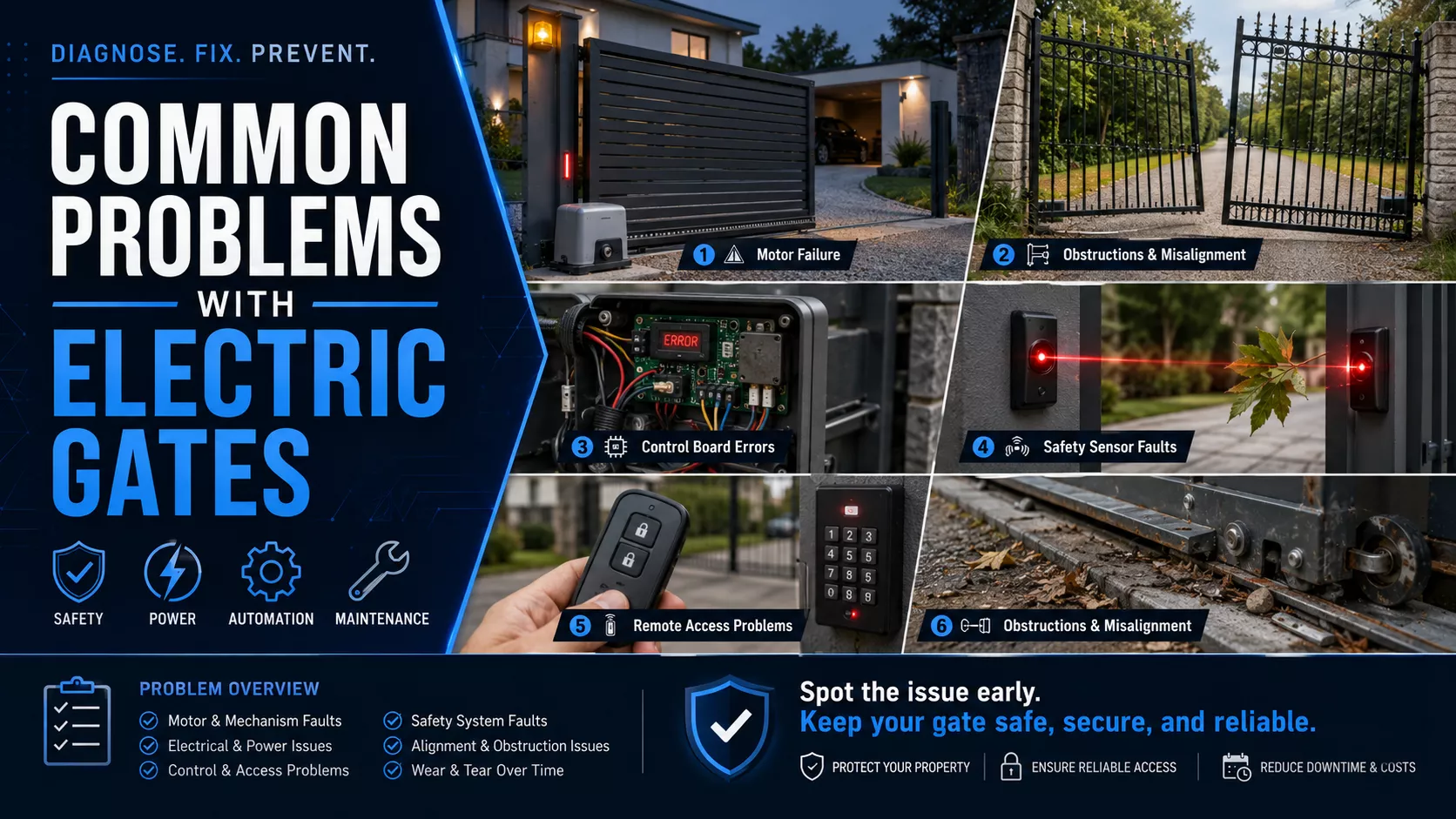
Electric gates experience various faults that affect performance, safety, and convenience. Identifying these issues early prevents costly repairs.
A frequent issue is the gate not opening or closing. This may result from:
- Remote control failures due to dead batteries or signal interference
- Sensor malfunctions where misaligned safety sensors block operation
- Obstructions like debris or vermin blocking gate tracks
Mechanical problems are also common. Gates may:
- Stick or jam from worn hinges or damaged rollers
- Produce unusual noises caused by loose components or a lack of lubrication
- Stay in manual mode due to disengaged motors
Electrical faults disrupt normal function. These include:
- Faulty wiring is creating intermittent power loss
- Control board failures are causing erratic behaviour
- Power outages disable automated operation
Gate motors can overheat or fail entirely from overuse or lack of maintenance. Even cosmetic damage, dents, rust, or paint deterioration, can worsen underlying structural weaknesses.
Regular inspections help detect these problems early, ensuring reliable gate function.
Which Routine Maintenance Tasks Keep Electric Gates Functional?
Routine maintenance preserves electric gate functionality, extends lifespan, and ensures safe operation. A structured approach combines visual inspections, cleaning, lubrication, and safety system testing.
Start with a thorough visual inspection to detect:
- Loose bolts or fasteners on hinges and brackets
- Signs of corrosion on metal components
- Frayed wiring or damaged cables
- Debris or vermin obstructing gate tracks
Next, perform cleaning to prevent build-up:
- Clear dirt and leaves from the gate tracks and around the sensors
- Clean safety photocells for unobstructed signal transmission
- Wipe control panels to prevent dust-related malfunctions
Apply lubrication to reduce friction:
- Grease hinges, rollers, and moving parts to minimise wear
- Avoid lubricating plastic parts or sensor covers, which can attract dirt
Conduct functional tests:
- Check safety sensors by obstructing them to verify the proper stop or reverse function
- Test remote controls for range and response
- Inspect motor operation for unusual sounds or delays
- Verify control board indicators for error signals
Regular completion of these tasks ensures uninterrupted operation, maximises component lifespan, and upholds safety compliance.
How Are Electric Gate Motors Repaired?
The electric gate motor drives the automated opening and closing process. When it malfunctions, accurate diagnosis and targeted repairs are essential to restore safe and reliable operation.
Common Motor Issues and Repairs
Problem | Cause | Diagnostic Action | Repair Solution |
Motor fails to start | Worn brushes, faulty capacitors | Check brushes, test capacitors | Replace brushes or capacitors |
Overheating | Excessive cycles, poor lubrication | Measure temperature, inspect moving parts | Lubricate parts, reduce duty cycle |
Unusual noises | Gear wear, misalignment | Inspect gears and shaft alignment | Replace gears, realign shaft |
Erratic movement | Control board communication failure | Read error codes, inspect wiring | Repair or replace control board |
Power loss | Loose connections, corroded wiring | Inspect and test connections | Secure or replace wiring |
Technicians use multimeters to test windings, verify continuity, and diagnose electrical faults. Control board error codes guide further investigation. Timely repairs preserve motor efficiency, comply with safety standards, and avoid costly full-system failures.
Why Are Safety System Inspections Essential for Electric Gates?
Safety system inspections are essential to prevent accidents, protect property, and ensure legal compliance. Electric gates incorporate multiple safety mechanisms that require regular verification to function correctly.
The photocell sensors detect obstacles. If misaligned or dirty, they fail to stop gate movement when objects are present. Inspectors:
- Clean sensor lenses to maintain clear detection paths
- Verify alignment to ensure accurate object recognition
- Test functionality by simulating obstruction scenarios
Obstruction force settings regulate how much pressure the gate applies before reversing. Faulty calibration can lead to injuries or equipment damage. Technicians:
- Measure applied force using calibrated tools
- Adjust settings according to manufacturer guidelines and safety standards like EN 12453
Emergency stop functions and manual release mechanisms are also inspected:
- Verify emergency stop response times
- Test manual release accessibility for emergency use
Control panels display system diagnostics. Inspectors:
- Read error logs for recorded safety breaches
- Check software updates to ensure optimal system response
Routine safety inspections ensure the gate meets regulatory standards, maintains insurance coverage, and protects users from harm.
When Are Emergency Repairs Needed for Electric Gates?
Emergency electric gate repairs ensure rapid response when unexpected failures compromise security or safety. Immediate intervention prevents further damage and restores access control swiftly.
Common emergency scenarios include:
- The gate is stuck open or closed, risking property security
- Motor failure leaves the gate inoperable
- Control board malfunctions, causing unresponsive systems
- Sensor failures disable safety mechanisms
- Power outages affecting gate automation
In such cases, contacting a 24/7 local gate repair service is essential. Professional technicians arrive equipped with diagnostic tools to identify faults quickly. They:
- Inspect electrical connections for faults or short circuits
- Test motor functionality to detect overheating or failure
- Check control systems for software or hardware errors
- Verify sensor alignment and operation
Emergency services often provide temporary manual operation solutions, such as safely disengaging the motor or using backup power units. This ensures controlled access until full repairs are completed.
Prompt emergency repairs minimise disruption, maintain security, and ensure user safety. Many service providers offer ongoing maintenance contracts that include priority emergency call-outs, ensuring continuous support when urgent issues arise.
Which Spare Parts and Components Need Replacement in Electric Gates?
Spare parts and component replacement keep electric gate systems operational, safe, and compliant. As components wear or fail, timely replacement prevents system breakdowns and extends overall lifespan.
Common Components Replaced in Electric Gates
Component | Common Issues | Replacement Purpose |
Motors & Gearboxes | Overheating, mechanical wear, failure | Restore gate movement and torque |
Control Boards | Electrical surges, moisture damage | Recover system logic and controls |
Safety Sensors | Misalignment, dirt, physical damage | Ensure obstacle detection |
Photocells | Lens obstruction, alignment failure | Maintain safety stop functions |
Remote Controls | Signal loss, button failure | Restore remote operation |
Keypads & Receivers | Communication errors | Restore user access control |
Limit Switches | Wear, faulty calibration | Ensure accurate gate positioning |
Wiring & Connectors | Corrosion, fraying, loose contacts | Secure electrical continuity |
Using manufacturer-approved spare parts maintains safety certifications, protects warranties, and ensures system compatibility. Professional technicians verify each component’s condition during routine servicing, replacing any parts that compromise system integrity or user safety.
Should You Choose Professional or DIY Maintenance for Electric Gates?
The choice between professional servicing and DIY maintenance depends on task complexity, safety, and legal compliance. While basic care can be managed by homeowners, advanced servicing requires expert intervention.
Comparison of Professional and DIY Electric Gate Maintenance
Task Type | DIY Maintenance | Professional Maintenance |
Visual Inspection | Check for visible damage, debris | Comprehensive system assessment |
Cleaning | Clean sensors, tracks, panels | Deep cleaning of internal components |
Lubrication | Lubricate hinges, rollers | Service moving parts with correct lubricants |
Electrical Repairs | Not recommended | Diagnose and repair wiring, motors, control boards |
Safety Calibration | Not recommended | Calibrate sensors, force settings, limit switches |
Legal Compliance | Cannot verify | Ensure compliance with EN 12453 and other standards |
Warranty Protection | May void warranties | Maintains warranty validity |
Incorrect DIY repairs risk safety breaches, system failures, and warranty voidance. Professional technicians possess specialist training, calibrated equipment, and regulatory knowledge to manage complex repairs safely and effectively.
What Are the Long-Term Maintenance and Repair Costs for Electric Gates?
The long-term costs of owning and maintaining electric gates include preventative maintenance, repair expenses, and electricity usage. Proactive servicing reduces expensive failures and extends system lifespan.
Breakdown of Long-Term Electric Gate Costs
Cost Category | Description | Typical Cost Impact |
Preventative Maintenance | Regular inspections, cleaning, lubrication, safety checks | Predictable annual cost (£100–£300) |
Minor Repairs | Replacing remotes, sensors, wiring fixes | Low to moderate (£50–£200 per repair) |
Major Repairs | Motor, gearbox, control board replacements | High (£300–£1,000+ per incident) |
Emergency Call-Outs | 24/7 urgent repair services | Higher rates (£100–£500 per visit) |
Electricity Consumption | Power used during operation and standby | Modest (under £50 per year for residential) |
Regular professional maintenance stabilises expenses, protects warranties, and reduces the likelihood of costly emergency repairs. Skipping routine care increases long-term costs significantly, especially for high-usage or commercial systems.
How Do Warranties and Service Contracts Protect Electric Gates?
Warranties and service contracts protect electric gate owners by covering different aspects of maintenance, repairs, and financial risk. Both play a crucial role in ensuring long-term system reliability and safety.
Comparison of Warranty and Service Contracts
Feature | Warranty Coverage | Service Contract Coverage |
Coverage Scope | Manufacturing defects in materials and workmanship | Routine maintenance tasks |
Duration | Typically 1–5 years | Ongoing, often annual or multi-year |
Included Services | Replacement of defective components | Inspections, cleaning, lubrication, safety checks |
Exclusions | Wear-and-tear, misuse, environmental damage, unauthorised repairs | Major repairs usually not included unless specified |
Professional Involvement | Required for authorised repairs | Includes regular visits by qualified technicians |
Warranty Protection | Maintains validity if professional servicing is used | Supports warranty compliance through documented maintenance |
A service contract ensures regular expert maintenance, preventing faults that could otherwise void the manufacturer’s warranty. Both agreements work together to maximise system performance, ensure safety compliance, and reduce long-term costs.
Frequently Asked Questions
Servicing costs range from £100 to £300 annually, depending on gate type, complexity, and service contract terms.
Maintenance includes inspections, cleaning sensors and tracks, lubricating moving parts, testing safety features, and checking electrical connections.
Residential gates need annual servicing; medium usage requires twice a year; commercial or heavy-use gates need 3–4 services per year.
Automatic gate maintenance involves regular inspections, safety system testing, cleaning, lubrication, minor repairs, and component replacements to ensure safe, reliable operation.