Table of Contents
- 1. What Are the Key Differences Between Powder Coating and Liquid Paint?
- 2. How Does the Application Process Differ for Powder Coating vs Liquid Paint?
- 3. Which Offers Better Durability and Performance: Powder Coating or Liquid Paint?
- 4. How Do Powder Coating and Liquid Paint Compare in Finish and Appearance?
- 5. What Is the Environmental Impact of Powder Coating vs Liquid Paint?
- 6. How Do the Costs of Powder Coating and Liquid Paint Compare?
- 7. When Should You Choose Powder Coating Instead of Liquid Paint?
- 8. What Are the Side-by-Side Differences Between Powder Coating and Liquid Paint?
What Are the Key Differences Between Powder Coating and Liquid Paint?
Powder coating and liquid paint both protect and colour surfaces, but they work in very different ways. The core distinction lies in the material state: powder is dry, paint is liquid.
Key Differences in Process and Properties:
- Powder uses electrostatic application, then cures in a high-heat oven, bonding particles into a smooth layer.
- Paint uses solvents to suspend pigment, sprayed or brushed on, and cures by air-drying or baking.
Practical Performance Differences:
- Durability comparison favours powder coating. It resists chips, corrosion and UV damage better than paint.
- Finish quality is more even with powder. Paint can drip or bubble.
- Coating thickness is greater with powder (2–8 mm vs. 0.5–1.5 mm), improving longevity.
- Curing time is shorter for powder (10–20 minutes) than for paint, which may need hours or days.
- VOC emissions from paint are higher. Powder is nearly VOC-free.
- Application method differs: powder needs an electrostatic gun and oven; paint needs a spray setup.
- Cost difference leans toward powder long-term, despite higher upfront equipment costs.
Powder Coating Advantages Over Liquid Paint:
- Less material waste
- Reusable overspray
- Lower environmental impact
- More durable in harsh conditions
Liquid Paint Disadvantages:
- Prone to fading and peeling
- Generates more waste
- Higher VOC emissions
- Needs more frequent reapplication
How Does the Application Process Differ for Powder Coating vs Liquid Paint?
Powder coating and liquid paint follow different paths from surface prep to finish. These differences affect cost, environmental control, skill level, and performance. Below is a clear breakdown:
Feature | Powder Coating | Liquid Paint |
Application Method | Electrostatic spray onto grounded metal | Spray, brush, or roll onto prepared surface |
Curing Time | 10–20 minutes in high-temperature oven | Varies: air-dry or oven-bake (up to hours) |
Coating Thickness | 2–8 mm on average | 0.5–1.5 mm depending on method and layers |
Durability Comparison | Superior resistance to chips and corrosion | Prone to cracking, peeling, and UV degradation |
Finish Quality | Smooth, even, with fewer defects | Risk of drips, bubbles, and uneven texture |
VOC Emissions | None, powder is solvent-free | High, solvent-based formulas emit VOCs |
Ease of Use | Needs training, specialised tools and oven | Easier for small jobs; basic tools sufficient |
Cost Difference | Higher upfront, lower long-term maintenance | Lower initial, higher lifecycle cost |
Powder coating offers clear advantages in sustainability, durability, and finish.
Which Offers Better Durability and Performance: Powder Coating or Liquid Paint?
Powder coating outperforms liquid paint in most durability tests. It forms a thick, bonded layer that resists harsh conditions better than paint.
The chart below compares performance based on key factors:
Feature | Powder Coating | Liquid Paint |
Abrasion Resistance | High – resists scratching and scuffing | Moderate – surface shows wear faster |
Corrosion Resistance | Excellent – forms a sealed protective layer | Weaker – prone to moisture penetration |
UV Resistance | Superior – maintains colour and gloss longer | Fades and chalks under long sun exposure |
Outdoor Longevity | Up to 20 years on metal surfaces | 3–7 years, often less in wet or sunny climates |
Indoor Longevity | Long-lasting with minimal upkeep | Requires frequent touch-ups in high-use areas |
Chip Resistance | Strong due to thermal bonding | Lower – chips easily with impact |
Finish Quality | Uniform, smooth finish without drips | Can show runs, bubbles, or brush marks |
Coating Thickness | 2–8 mm for stronger coverage | 0.5–1.5 mm, thinner with less protection |
Curing Time | 10–20 mins in oven | Hours to dry or cure fully |
VOC Emissions | None – eco-friendly | High – requires ventilation and protective gear |
In the powder coating vs liquid paint comparison, powder coating holds the edge in strength, finish quality, and environmental safety.

Powder Coating or Liquid Paint Offers Better Durability and Performance
How Do Powder Coating and Liquid Paint Compare in Finish and Appearance?
Powder coating creates a thicker, more uniform finish that covers edges and corners without sagging. It gives a textured or matte look and resists visual wear. Liquid paint offers finer gloss control and smoother finishes but may run, drip, or require several coats. Finish quality also depends on the skill of the applicator. Powder is more consistent, while paint allows more custom blending. Both methods offer colour variety, but powder limits in-the-moment mixing.
Visual appearance depends on:
- Desired gloss or texture
- Substrate material
- Use case (indoor vs outdoor)
Here’s a side-by-side comparison:
Feature | Powder Coating | Liquid Paint |
Application Method | Electrostatic spray + oven cure | Spray, brush, roll + air or oven dry |
Coating Thickness | 60–150 µm (thicker, uniform) | 20–50 µm (thinner, variable) |
Finish Quality | Smooth, durable, textured or matte | Glossy, metallic, customisable |
Durability | High – resists chips and scratches | Lower – prone to wear, needs touch-ups |
VOC Emissions | None – eco-friendly | High – solvent-based, polluting |
Curing Time | 10–30 mins in oven | Hours to days (depends on type and thickness) |
Cost Difference | Higher upfront (equipment) | Lower setup, higher long-term maintenance |
What Is the Environmental Impact of Powder Coating vs Liquid Paint?
Powder coating has clear environmental advantages over liquid paint. It releases nearly zero VOC emissions, making it safer for workers and cleaner for the air. Liquid paint, by contrast, emits harmful volatile organic compounds during application and curing, contributing to air pollution. Powder coating also supports overspray recovery; unused powder can be reclaimed and reused, which reduces waste. In liquid painting, overspray becomes hazardous waste.
From a regulatory standpoint, powder coating aligns better with ISO 14001, AAMA 2604, and EPA air quality standards, offering manufacturers compliance benefits. This also lowers disposal and ventilation costs.
Aspect | Powder Coating | Liquid Paint |
VOC Emissions | Near zero | High (solvent-based) |
Overspray Recovery | Yes, reclaimable | No, mostly wasted |
Regulatory Compliance | Easier with EPA, ISO, AAMA | Stricter limits and treatment are required |
Waste Disposal | Low hazard | Requires special handling |
Coating Thickness | Thicker, more uniform | Thinner, variable |
How Do the Costs of Powder Coating and Liquid Paint Compare?
Powder coating has a higher upfront cost than liquid paint, but it often reduces expenses over time. The equipment and powder material cost more, yet powder coating advantages include minimal rework, stronger durability, and lower maintenance. In contrast, liquid paint may seem cheaper, but VOC emissions, thinner coating thickness, and reapplication needs raise long-term costs.
Powder coating typically costs £2–£4 per sq ft, while liquid paint averages £1–£2, but powder lasts 2–3 times longer. Over the years, cost differences even out through reduced touch-ups and better finish quality.
Cost Factor | Powder Coating | Liquid Paint |
Upfront Price | Higher (equipment, powder) | Lower (materials, tools) |
Per Sq Ft Cost | £2–£4 | £1–£2 |
Long-Term Maintenance | Minimal | Frequent touch-ups |
Durability Comparison | Lasts up to 20 years | Shorter lifespan |
Application Method | Electrostatic + oven curing | Spray or brush |
Curing Time | Fast (20 mins) | Slow (hours to days) |
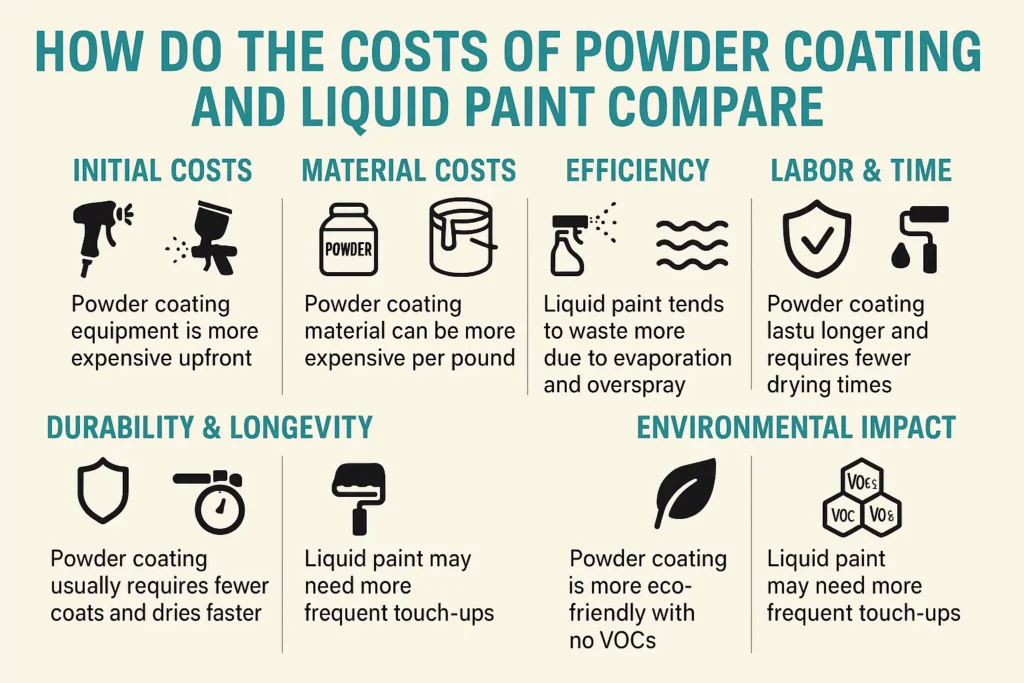
The Comparison of Powder Coating and Liquid Paint Costs
When Should You Choose Powder Coating Instead of Liquid Paint?
Choose powder coating when durability, outdoor exposure, or efficiency matters most. It suits metal items like railings, machinery, wheels, and garden furniture. Its thick coating resists rust, chips, and UV damage. The application method offers excellent coverage and uniform finish quality, even on complex parts. A single coat often suffices, reducing curing time and material use.
Use liquid paint when coating heat-sensitive substrates, like wood or plastic, or when needing precise colour matching and high gloss. It fits smaller jobs with budget constraints or when thin layers are vital.
Use Case | Powder Coating | Liquid Paint |
Durability Comparison | Long-term wear resistance | Prone to scratches or fading |
Coating Thickness | Thick, uniform, protective | Thin, but flexible |
VOC Emissions | Zero to minimal | High, depending on formula |
Application Method | Electrostatic spray + oven | Spray, brush, or dip |
Curing Time | 10–20 minutes (heated) | Hours to days (air-dry or oven) |
Cost Difference | Higher setup, lower maintenance | Lower setup, higher upkeep |
What Are the Side-by-Side Differences Between Powder Coating and Liquid Paint?
Powder coating vs liquid paint shows clear contrasts in durability, environmental impact, and efficiency. Powder uses an electrostatic application method followed by high-heat curing, forming a dense layer that resists corrosion and wear. Liquid paint is simpler to apply with a brush or spray, but it often requires multiple coats and a longer curing time.
Powder’s finish quality is thicker and more uniform, preventing drips. In contrast, paint may sag or run, especially on vertical surfaces. VOC emissions are near zero in powder coating, while liquid paint can emit high levels during drying. Though powder has higher setup costs, its cost efficiency improves over time through reduced waste and longer durability.
Feature | Powder Coating | Liquid Paint |
Application Method | Electrostatic spray | Spray, brush, or roller |
Curing Time | Heat oven (10–20 mins) | Air dry or oven (hours/days) |
Durability Comparison | Very high | Moderate to high |
VOC Emissions | None | Moderate to high |
Cost Difference | High upfront, low upkeep | Low upfront, higher upkeep |
Coating Thickness | Thick and even | Thin, prone to drips |
Finish Quality | Smooth, no brush marks | Can be uneven or streaky |