Table of Contents
- 1. What Is the Difference Between Thermoset and Thermoplastic Powder Coatings?
- 2. How Does Thermoset Powder Coating Work and What Makes It Unique?
- 3. How Does Thermoplastic Powder Coating Work and When Is It Used?
- 4. What Are the Key Differences Between Thermoset and Thermoplastic Powders?
- 5. What Are the Advantages and Disadvantages of Thermoset and Thermoplastic Coatings?
- 6. How Do You Choose Between Thermoset and Thermoplastic Powder Coatings?
- 7. How Do Cost and Availability Compare for Thermoset vs Thermoplastic Powders?
What Is the Difference Between Thermoset and Thermoplastic Powder Coatings?
Thermoset and thermoplastic powder coatings are two types of powder coating with different structures and heat behaviours. The main difference comes from their chemical reactions during curing. Thermosets create permanent cross-links through a chemical cross-linking process. Thermoplastics do not bond chemically, allowing re-melting after cooling.
Thermoset powder coatings, like epoxy powder coating or polyester powder, harden permanently. Once cured, they resist high heat and offer abrasion resistance, dimensional stability, and low cost. They’re widely used for appliances, automotive parts, and electrical systems, but they can’t be recycled.
Thermoplastic coatings, such as nylon coatings, remain meltable after curing. These coatings are tough, flexible, and repairable. They suit products like refrigerator racks, piping, and medical equipment. Their ability to remelt supports sustainable applications, but they cost more and are less heat-resistant.
Here’s a comparison of key properties:
Feature | Thermoset Powder Coatings | Thermoplastic Powder Coatings |
Curing Process | Chemical cross-linking | No chemical reaction |
Heat Behaviour | Irreversible bond, does not re-melt | Softens and re-melts |
Durability and Heat Resistance | High durability, heat and chemical resistance | Good durability, limited heat resistance |
Recyclability | Not recyclable | Recyclable and remouldable |
Common Materials | Epoxy, polyester | Nylon, PVC, polyethene |
Application Examples | Automotive, appliances, electronics | Wire racks, fences, medical furniture |
Cost | Lower | Higher |
How Does Thermoset Powder Coating Work and What Makes It Unique?
Thermoset powder coating creates a durable and irreversible finish through a chemical process. It differs from thermoplastic coating properties, where the powder can re-melt. The curing process in thermosets forms a permanent structure that resists breakdown under heat.
Key process steps and features:
- Electrostatic application charges the powder, attracting it to the grounded surface.
- Heat initiates melting, allowing the powder to flow over the metal.
- Chemical cross-linking occurs, forming a new polymer structure.
- An irreversible bond forms, which can’t be melted again.
- Durability and heat resistance increase due to molecular transformation.
Examples of common materials used:
- Epoxy powder coating offers high corrosion resistance but low UV stability.
- Polyester powder provides better outdoor performance and UV resistance.
- Hybrid powders combine epoxy and polyester for balanced properties.
Thermoset powder coating advantages are clear in the thermoset vs thermoplastic powder coating comparison: it offers stronger protection where re-melting is not desired.
Property | Thermoset Coating | Thermoplastic Coating |
Chemical Reaction | Yes, cross-linking | No reaction |
Re-melting Possibility | No, irreversible bond | Yes, reversible |
Main Resins Used | Epoxy, polyester, hybrid | Nylon, PVC, polyethene |
Durability and Heat Resistance | High | Moderate |
Typical Use Cases | Appliances, automotive, electronics | Wire racks, piping, medical parts |
How Does Thermoplastic Powder Coating Work and When Is It Used?
Thermoplastic powder coatings create a protective layer by melting and solidifying without changing chemically. This sets them apart in the thermoset vs thermoplastic powder coating comparison. Thermoplastics are known for re-melting and recycling, making them a reversible coating option with strong thermoplastic coating properties.
Key process features:
- Powder application uses electrostatic spraying or fluidised bed dipping for full surface coverage.
- Heat softens the powder, allowing it to flow and form a smooth film.
- No chemical cross-linking occurs, so the bond remains physical, not permanent.
- Cooling solidifies the layer, ready for use or future re-melting if needed.
Common materials:
- Nylon coatings: High abrasion and impact resistance.
- PVC: Cost-effective with good corrosion resistance.
- Polyethene: Tough, flexible, and chemically resistant.
Applications include:
- Automotive trim, white goods, wire racks, pipes, fences
- Marine, oil and gas equipment
- Architectural and industrial metalwork
Thermoplastic coatings offer durability and heat resistance for mid-range temperatures. They lack chemical cross-linking, but their repairability and sustainability provide clear advantages where remelting is a benefit.
Feature | Thermoplastic Powder Coating | Thermoset Powder Coating |
Chemical Change | No | Yes, cross-linking |
Re-melting Capability | Yes | No |
Common Examples | Nylon, PVC, polyethene | Epoxy, polyester |
Durability and Heat Resistance | Moderate durability, reworkable | High durability, permanent |
Environmental Impact | Recyclable, low VOCs | Non-recyclable, low VOCs |

Thermoplastic Powder Coating Work and Used List
What Are the Key Differences Between Thermoset and Thermoplastic Powders?
Thermoset and thermoplastic powders differ in how they behave during the curing process and under heat. These differences affect their reusability, strength, and suitability for applications. Understanding their unique traits helps in choosing the right material for specific performance needs.
- Thermoset powders use chemical cross-linking to form an irreversible bond when heated.
- Thermoplastic powders melt and solidify without changing chemically, allowing re-melting and reshaping.
- Thermoset powder coating advantages include higher heat resistance, dimensional stability, and durability in extreme environments.
- Thermoplastic coating properties offer flexibility, ease of repair, and recyclability.
Thermosets, such as epoxy powder coating and polyester powder, are preferred for automotive and industrial use. Thermoplastics like nylon coatings suit applications requiring insulation and impact resistance.
Feature | Thermoset Powder | Thermoplastic Powder |
Curing | Irreversible (chemical cross-linking) | Reversible (melting and solidifying) |
Heat Resistance | Higher | Moderate |
Durability | Very high (rigid, hard) | Good (flexible, tough) |
Reusability | Cannot be remelted or reshaped | Can be remelted and reshaped |
Use Cases | Automotive parts, electronics, machinery | Wire coatings, piping, insulation materials |
What Are the Advantages and Disadvantages of Thermoset and Thermoplastic Coatings?
Thermoset and thermoplastic coatings suit different needs based on durability, recyclability, heat resistance, and application method. The curing process and chemical cross-linking define their performance, cost, and environmental impact. Here’s how the two compare in practical use:
Thermoset Powder Coating Advantages
- Forms a permanent structure through cross-linking
- Provides high durability and heat resistance
- Resists chemicals, abrasion, and corrosion
- Offers good dimensional stability under pressure
- Compatible with thin films and epoxy powder coating, or polyester powder
Thermoset Powder Coating Disadvantages
- Not recyclable after curing
- Cannot be re-melted or reshaped
- Surface finishing can be harder to control
- May become brittle under impact
- Lower thermal conductivity for certain uses
Thermoplastic Coating Advantages
- Re-meltable and recyclable
- Flexible and impact-resistant
- Strong adhesion to metals
- Works well for nylon coatings and polyolefins
- Ideal for electrical insulation and industrial coating
- Allows for smooth finishes and rework
Thermoplastic Coating Disadvantages
- Softens under heat (limits high-temp use)
- May degrade in UV or outdoor exposure
- Can be more expensive than thermosets
- Requires thicker films for equal protection
Thermoset vs thermoplastic powder coating selection depends on whether durability or reusability matters more.
How Do You Choose Between Thermoset and Thermoplastic Powder Coatings?
Choosing between thermoset and thermoplastic powder coating depends on the job’s needs. The curing process, chemical structure, and application conditions guide the decision. Some coatings work better in heat, others in impact-prone environments.
Use Thermoset Powder Coating When:
- You need strong heat resistance and chemical protection
- The item stays in a fixed shape and won’t need reworking
- You want lower cost for high-volume or industrial applications
- Common choices: epoxy powder coating, polyester powder
Use Thermoplastic Coating When:
- The item needs flexibility and impact resistance
- You expect corrosion, wear, or electrical exposure
- Re-melting or recycling is valuable in your process
- Suitable for nylon coatings, fences, and playground parts
Thermoset vs thermoplastic powder coating boils down to environment, material compatibility, and cost-performance balance
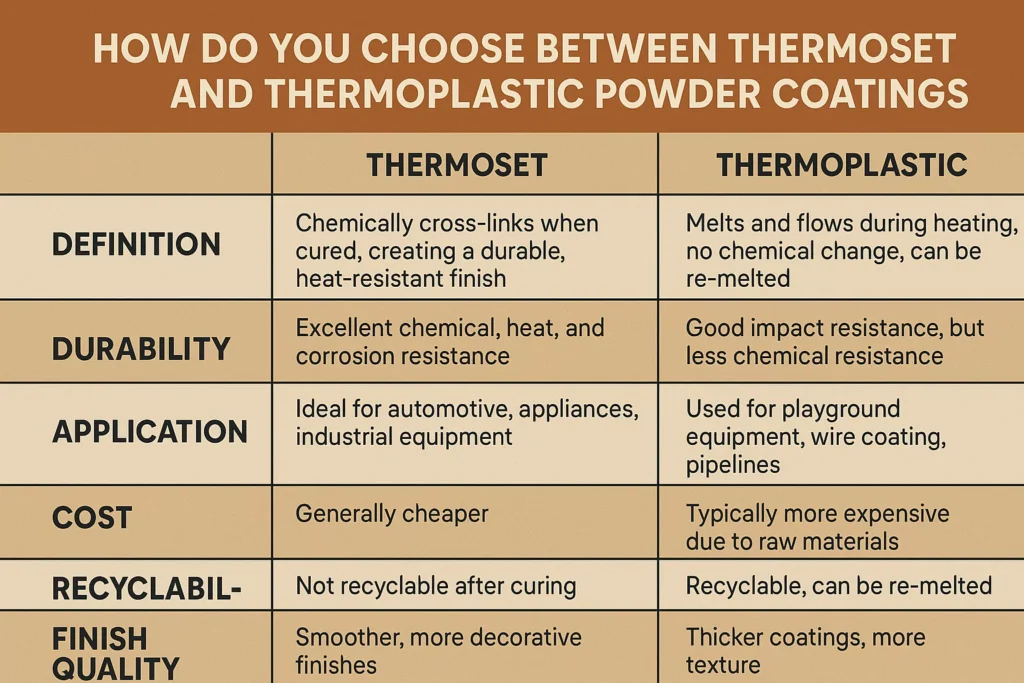
Thermoset and Thermoplastic Powder Coatings Compare Chart
How Do Cost and Availability Compare for Thermoset vs Thermoplastic Powders?
Cost and availability depend on the powder type, equipment setup, and production scale. Thermoset powders like epoxy or polyester are cheaper per kilo and need simpler tools. Their curing process uses chemical cross-linking, creating irreversible bonds. That keeps production costs low, especially for high-heat or heavy-use parts.
Thermoplastic powders like nylon coatings cost more but support re-melting. They need higher heat and specialised gear like fluidised beds. Their durability and chemical resistance suit outdoor or flexible-use parts, but the upfront cost is higher.
Feature | Thermoset Powder Coating | Thermoplastic Powder Coating |
Raw Material Price | Lower (e.g. epoxy, polyester) | Higher (e.g. nylon, polyethene) |
Application Method | Spray then cure | Dip or electrostatic with re-melt |
Equipment Needed | Basic oven | Preheat systems, fluidised beds |
Finish Durability | High under heat and wear | High impact and chemical resistance |
Recyclability | No (irreversible bonds) | Yes (re-meltable) |