Table of Contents
- 1. What Are the Recent Innovations Driving Powder Coating Technology?
- 2. How Do Low-Temperature Cure Powders Enable Coating on Heat-Sensitive Materials?
- 3. How Do Antimicrobial and Anti-Graffiti Powder Coatings Enhance Surface Protection?
- 4. What Functionalities Do Smart Powder Coatings Provide for Industrial Applications?
- 5. How Does Powder Coating Improve the Durability of 3D-Printed Parts?
- 6. Why Are Powder Coatings Considered Sustainable and Eco-Friendly?
- 7. What Are the Future Trends Shaping Powder Coating Innovations?
What Are the Recent Innovations Driving Powder Coating Technology?
Recent innovations in powder coating target sustainability, efficiency, and advanced material performance. Manufacturers integrate bio-based resins to reduce dependency on petrochemicals, aligning with environmental regulations and lowering carbon footprints. These resins, derived from renewable sources like soy or cashew nut shells, offer comparable adhesion and flexibility.
Nanotechnology plays a significant role in enhancing mechanical properties. Nanoparticles, such as silica or alumina, embed into the powder matrix, increasing abrasion resistance, UV stability, and chemical resistance. This results in longer-lasting protective coatings for automotive, aerospace, and architectural applications.
Low-temperature curing systems enable curing at temperatures as low as 120°C. This reduces energy consumption by up to 30% and broadens substrate compatibility, including heat-sensitive materials like plastics and composites. Consequently, manufacturers achieve cost savings and environmental benefits without compromising coating integrity.
Further, smart coatings incorporating self-healing, anti-microbial, and anti-graffiti functionalities emerge, addressing specialised industry demands. These features enhance product lifespans while reducing maintenance requirements. Innovations also extend to application technology. Advanced electrostatic spray systems and digital control improve transfer efficiency and film uniformity, minimising waste and ensuring consistent quality across complex geometries.
How Do Low-Temperature Cure Powders Enable Coating on Heat-Sensitive Materials?
Low-temperature cure powders expand powder coating applications to heat-sensitive substrates like MDF, plywood, plastics, and composites. These materials deform under high heat, so coatings that cure at reduced temperatures are essential for maintaining structural integrity.
Manufacturers formulate these powders to cure efficiently at 250–260°F (121–127°C). Traditional powders require curing at 375°F (191°C), but advanced chemistries now enable full crosslinking at significantly lower temperatures. This shift delivers considerable energy savings, cutting operational costs by up to 30%.
To apply powder coatings on non-conductive substrates, surface pre-treatment is mandatory. Techniques like conductive priming, flame treatment, or corona discharge create a temporary conductive layer, allowing electrostatic attraction of powder particles.
Energy efficiency and substrate versatility drive the demand for low-temp powders in industries like furniture, automotive interiors, and consumer electronics. These sectors benefit from the ability to coat lightweight, complex geometries without warping or degradation.
Advances in resin technology, particularly with hybrid and polyester systems, ensure that mechanical properties like adhesion, flexibility, and chemical resistance remain uncompromised, even at lower curing temperatures.
How Do Antimicrobial and Anti-Graffiti Powder Coatings Enhance Surface Protection?
Antimicrobial and anti-graffiti coatings offer advanced surface protection across multiple industries. Both technologies enhance hygiene, durability, and maintain aesthetic quality.
Antimicrobial Coatings
- Mode of action: Coatings incorporate agents that inhibit bacterial, fungal, and viral growth. Active substances include silver ions, copper alloys, and photocatalytic materials.
- Healthcare applications: Used on medical devices, hospital surfaces, and sterilisation equipment to reduce healthcare-associated infections (HAIs). In the US, HAIs contribute to nearly 100,000 deaths annually.
- Other sectors: Applied to textiles, clothing, consumer electronics, and food processing equipment to prevent microbial contamination.
- Surface functionalisation: Achieved through chemical compounds, polymer adsorption, or modifying micro and nanostructures to create inhospitable environments for microorganisms.
- Material examples: Copper alloys (brass, bronze, cupronickel) show intrinsic antimicrobial activity, destroying pathogens like MRSA, E. coli, C. difficile, and influenza viruses.
Anti-Graffiti Coatings
- Protective properties: Form barriers that prevent paint and markers from bonding to surfaces, allowing easy graffiti removal with specialised cleaning agents.
- Durability: Coatings withstand multiple cleaning cycles without altering gloss or colour.
- Applications: Common on metallic substrates such as aluminium, galvanised steel, and blank steel.
- Use cases: Rail vehicles, noise barriers, facades, seat frames, ceiling panels, and interior metal surfaces.

Enhanced Surface Protection with Antimicrobial and Anti-Graffiti Powder Coatin
What Functionalities Do Smart Powder Coatings Provide for Industrial Applications?
Smart and functional powder coatings deliver advanced performance by responding to external stimuli or integrating additional protective features. They serve industries requiring enhanced durability, efficiency, and safety.
Type | Mechanism | Applications | Benefits |
Self-Healing Coatings | Microcapsules release healing agents into cracks | Automotive, aerospace, infrastructure | Extends service life, reduces maintenance |
Temperature-Regulating | Phase-change materials or reflective pigments | Building facades, vehicles, and electronics | Stabilises temperatures, improves efficiency |
Antimicrobial Coatings | Silver ions, copper particles, and photocatalysis | Healthcare, food processing, and public surfaces | Reduces microbial contamination |
Conductive/ESD Coatings | Conductive fillers like carbon nanotubes | Electronics, explosive environments | Controls static, ensures safety |
These coatings combine functionality and efficiency. For example, self-healing systems autonomously repair minor damage, preserving protective layers. Temperature-regulating coatings help manage heat transfer, lowering energy costs in climate-sensitive environments.
Antimicrobial formulations inhibit bacteria, viruses, and fungi, ensuring hygiene in critical settings. Electrostatic dissipative (ESD) coatings control charge build-up, preventing equipment damage or hazardous sparks.
Industries such as aerospace, automotive, healthcare, construction, and electronics widely adopt these innovations for superior product performance and operational safety.
How Does Powder Coating Improve the Durability of 3D-Printed Parts?
Powder coating enhances the mechanical strength, aesthetics, and longevity of 3D printed parts. It offers a reliable post-processing solution for both metal and certain plastic substrates, aligning with the evolving demands of additive manufacturing.
Aspect | Details |
Application Process | Electrostatic powder deposition followed by heat curing. |
Compatible Materials | – Metals: Aluminium, stainless steel, titanium – Plastics: Nylon, ABS, composites (with low-temp curing) |
Functional Benefits | – Increased impact resistance – Improved surface hardness – Wide colour, texture, and gloss options – UV and corrosion protection |
Environmental Advantages | – Low waste production – No VOC emissions – Energy-efficient curing options |
Industrial Applications | – Aerospace components – Automotive prototypes – Medical devices – Consumer electronics – Custom architectural elements |
The ability to apply low-temperature curing powders allows sensitive plastic 3D printed parts to receive durable, uniform coatings without deformation. For metal 3D prints, powder coating adds superior protection against wear, corrosion, and UV degradation.
Manufacturers increasingly integrate powder coating into 3D printing workflows to produce functional, visually appealing, and long-lasting components suitable for both prototyping and final products.
Why Are Powder Coatings Considered Sustainable and Eco-Friendly?
Sustainable and eco-friendly powder coatings address environmental concerns while maintaining high-performance standards. Unlike traditional liquid paints, powder coatings generate minimal waste and contain no volatile organic compounds (VOCs), eliminating hazardous air pollutants during application.
Material Efficiency:
- Overspray recovery: Unused powder can be collected and reused, achieving nearly 98% material utilisation.
- No solvents: Eliminates the need for harmful solvents, reducing fire hazards and operator exposure.
Environmental Impact:
- Zero VOC emissions: Powder coatings comply with stringent air quality regulations, contributing to cleaner production environments.
- Reduced carbon footprint: Lower curing temperatures, especially with bio-based resins, decrease energy consumption significantly.
Sustainable Formulations:
- Bio-based resins: Derived from renewable resources such as soy, castor oil, or cashew nutshell liquid, reducing reliance on petrochemicals.
- Heavy-metal free pigments: Modern formulations avoid toxic substances like lead or chromium, improving end-of-life recyclability.
Industrial Adoption:
- Applied in the automotive, architectural, appliance, and furniture industries, seeking green certifications and sustainable manufacturing goals.
Eco-friendly powder coatings combine environmental responsibility with technical performance, supporting both regulatory compliance and corporate sustainability initiatives.
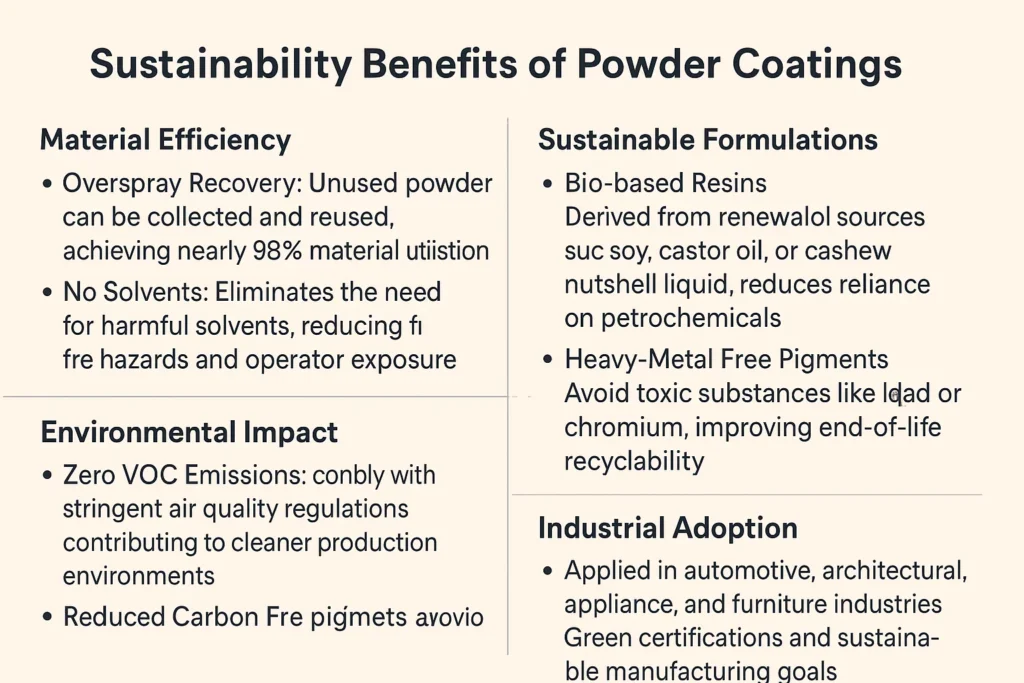
Eco-Friendly and Sustainable Options in Powder Coatings
What Are the Future Trends Shaping Powder Coating Innovations?
Future trends in powder coating focus on sustainability, advanced functionality, and broader industrial applications. Ongoing innovations are reshaping how industries adopt surface finishing technologies.
Sustainability Advancements
- Bio-based resins: Derived from renewable raw materials, reducing dependence on petrochemical sources.
- Energy-efficient curing: Development of low-cure powder coatings operating at reduced temperatures lowers energy consumption and broadens substrate compatibility.
- Zero-VOC formulations: Continued elimination of volatile organic compounds supports stricter environmental regulations.
Technological Innovations
- Nanocoatings: Incorporation of nanoparticles such as silica, titanium dioxide, or alumina enhances scratch resistance, UV stability, and chemical durability.
- High-temperature resistance: Advanced chemistries enable coatings to withstand extreme heat, vital for aerospace, automotive, and industrial machinery applications.
- Smart coatings: Self-healing, anti-microbial, anti-graffiti, and temperature-regulating functions improve durability, hygiene, and safety.
Expanding Industrial Applications
- Electric vehicles (EVs): Powder coatings protect battery enclosures, electrical components, and lightweight structural elements, supporting thermal management and corrosion resistance.
- 3D printing integration: Post-processing of 3D printed parts with powder coatings enhances mechanical performance and surface aesthetics.
- Architectural and infrastructure: Greater demand for long-lasting, environmentally friendly coatings for buildings, bridges, and public installations.
As powder coating technology evolves, manufacturers gain access to multifunctional, sustainable, and efficient solutions that meet emerging industry demands and regulatory standards.