Table of Contents
- 1. When Should You Recoat Powder-Coated Surfaces and Why Is It Necessary?
- 2. How Should You Prepare a Surface for Recoating
- 3. How Can You Select the Right Powder for Recoating?
- 4. What Are the Best Application Methods for Recoating?
- 5. How Do You Cure and Maintain Coatings After Recoating?
- 6. What Challenges Occur During Recoating and How Can You Solve Them?
When Should You Recoat Powder-Coated Surfaces and Why Is It Necessary?
Recoating powder-coated surfaces becomes essential when functional or visual integrity declines. Powder coatings resist wear, but long-term exposure to environmental and mechanical factors degrades their performance.
When to Recoat
Condition | Cause | Indicator | Action Required |
Chipping & Peeling | Impact, abrasion, or poor initial adhesion | Visible flakes or detached coating | Strip and recoat fully |
Fading & Discolouration | UV radiation, weather exposure | Colour loss or dullness | Light sanding and recoat |
Cracking | Thermal cycling, ageing | Hairline fractures on surface | Strip and recoat |
Corrosion Development | Breach in coating, moisture ingress | Rust spots or pitting | Remove corrosion, full recoat |
Aesthetic Update | Design change or branding update | Colour or finish no longer suitable | Clean and apply new coat |
Why Recoating is Performed
- Restores appearance: Brings surfaces back to original or updated visual standards.
- Renews protection: Re-establishes barrier against moisture, chemicals, and UV.
- Extends lifespan: Delays need for costly replacement by maintaining substrate integrity.
How Should You Prepare a Surface for Recoating
Surface preparation ensures proper adhesion and durability of the new powder coating. Contaminants and inadequate surface profiles compromise coating performance.
Key Surface Preparation Steps
Preparation Stage | Purpose | Method Used | Inspection Criteria |
Cleaning | Remove contaminants | Alkaline cleaning, degreasing, solvent wiping | No visible oils, dust or residues |
Coating Removal | Eliminate loose or failed layers | Abrasive blasting, chemical stripping | No remaining flaking areas |
Surface Profiling | Create bonding texture | Sanding, bead blasting, chemical etching | Uniform surface roughness |
Final Inspection | Verify readiness | Visual check, white-glove test, profilometer reading | Clean, defect-free surface |
Why Surface Preparation Matters
- Promotes adhesion: Roughened profiles allow coating powders to anchor securely.
- Prevents defects: Clean surfaces minimise blistering, peeling, or coating failure.
- Extends lifespan: Proper preparation supports long-term coating performance.
Technicians must follow precise preparation protocols tailored to substrate material, existing damage, and coating type. Improper preparation leads to costly recoating failures.
How Can You Select the Right Powder for Recoating?
Selecting the appropriate powder coating ensures strong adhesion, durability, and optimal aesthetics. Multiple factors must align for a successful recoating process.
Key Factors in Powder Selection
Factor | Consideration | Recommended Powder Type | Purpose |
Substrate Type | Aluminium, steel, galvanised metals | Polyester, epoxy, hybrids | Ensure adhesion and flexibility |
Environmental Conditions | UV exposure, moisture, chemicals | UV-resistant polyester, epoxy, superdurables | Prevent fading, corrosion, and chemical attack |
Existing Coating | Compatibility with old layer | Same chemistry preferred (e.g. polyester over polyester) | Maintain adhesion and minimise delamination |
Coating Thickness | Avoid excessive buildup | Controlled powder application | Prevent brittleness and curing issues |
Service Environment | Marine, industrial, architectural | High salt spray resistance, chemical resilience | Extend coating lifespan and durability |
Why careful selection matters
- Prevents failures: Poor powder choice leads to peeling, cracking, or discolouration.
- Enhances performance: Correct powders withstand environmental stresses.
- Improves aesthetics: Compatible powders deliver uniform finishes.
Technicians conduct substrate analysis, service condition assessments, and compatibility tests before powder selection. This ensures optimal recoating results.

Powder Selection Guide for Recoating
What Are the Best Application Methods for Recoating?
Recoating methods vary depending on the material, coating system, and intended finish. Correct application techniques ensure proper adhesion and long-term durability.
Powder Coating Application Adjustments
Powder recoating requires precise control of:
- Spray gun settings: Voltage, distance, and air pressure must be adjusted to prevent excessive film build and ensure even coverage.
- Curing cycles: Extended or modified curing profiles prevent undercure or overbake, which can affect adhesion and finish quality.
- Surface grounding: Proper grounding eliminates electrostatic issues that may cause uneven powder deposition.
Liquid Coating Reapplication
When applying liquid topcoats:
- Surface preparation: Light sanding (screening) removes minor imperfections and promotes adhesion.
- Cleaning: Dust, oil, and debris must be eliminated to avoid finish defects.
- Application: Brushes, rollers, or spray guns distribute coatings evenly, depending on the surface geometry and finish requirements.
Spot Recoating and Partial Repairs
In some cases, only damaged sections require treatment:
- Localised sanding: Smooths transition zones between existing and new coatings.
- Feathering: Blends new coating edges seamlessly into existing layers.
Epoxy and Specialised Systems
Recoating epoxy surfaces involves:
- Recoat windows: Applying new layers within specific timeframes to ensure chemical bonding.
- Surface abrading: If outside recoat window, sanding is necessary to restore adhesion capability.
Precise application techniques prevent adhesion failures, appearance defects, and premature degradation.
How Do You Cure and Maintain Coatings After Recoating?
Curing and post-coating care ensure that recoated surfaces achieve maximum durability, adhesion, and aesthetic quality. Each coating system demands specific curing protocols and aftercare routines.
Curing and Care Guidelines
Stage | Action Required | Details | Purpose |
Initial Curing | Heat curing (Powder coatings) | 160–200°C for 10–30 minutes | Complete cross-linking and adhesion |
| Ambient or elevated curing (Epoxy, Liquid) | Follow manufacturer’s specified cure times | Ensure chemical bonding |
| Bonding period (Ceramic coatings) | 2–3 weeks of ambient bonding | Harden coating, form protective barrier |
Post-Curing | Avoid contaminants | No washing, tree sap, bird droppings | Prevent surface defects during curing |
Maintenance | Regular washing | Use pH-neutral car wash products | Preserve coating integrity |
| Drying | Use microfiber towels | Prevent scratches and water spots |
| Inspection | Check for damage or contamination | Early detection of issues |
Why Proper Curing and Care Matter
- Ensures full mechanical strength.
- Maximises chemical and UV resistance.
- Prevents premature coating failure.
Failure to follow these steps can lead to reduced coating lifespan, compromised appearance, and costly repairs.
What Challenges Occur During Recoating and How Can You Solve Them?
Recoating presents multiple challenges that can compromise adhesion, appearance, and durability. Identifying problems early allows for targeted solutions that maintain coating performance.
Typical Recoating Challenges and Solutions
Challenge | Cause | Solution | Preventive Action |
Poor Adhesion | Insufficient cleaning or priming | Thorough cleaning, correct primer usage | Full surface preparation and compatibility check |
Blistering/Peeling | Moisture, improper curing, incompatible coatings | Control environment, verify coating compatibility | Follow curing specifications |
Staining/Bleeding | Existing stains or old coatings | Use stain-blocking primers | Remove stains and test previous coatings |
Application Defects | Heavy application, incorrect mixing | Apply thin, even coats; follow mixing ratios | Follow manufacturer’s application guidelines |
Environmental Issues | Extreme temperature, humidity, dew point | Monitor and control environmental conditions | Apply coatings within recommended climate range |
Incomplete Coverage | Missed areas or uneven application | Inspect and reapply as needed | Use proper lighting and application techniques |
Uneven Thickness | Over-application or under-application | Apply multiple thin coats | Use wet film gauges to monitor thickness |
Cracking/Chipping | Substrate cracks, excessive shrinkage | Repair substrate before recoating | Inspect and fix surface imperfections |
Falling Debris | Loose fasteners or external contaminants | Secure components and maintain clean area | Inspect environment prior to recoating |
Health Hazards | Exposure to hazardous powders | Wear PPE and follow safety protocols | Ensure proper ventilation and handling |
Professional assessment often prevents recurring issues, especially for complex projects.
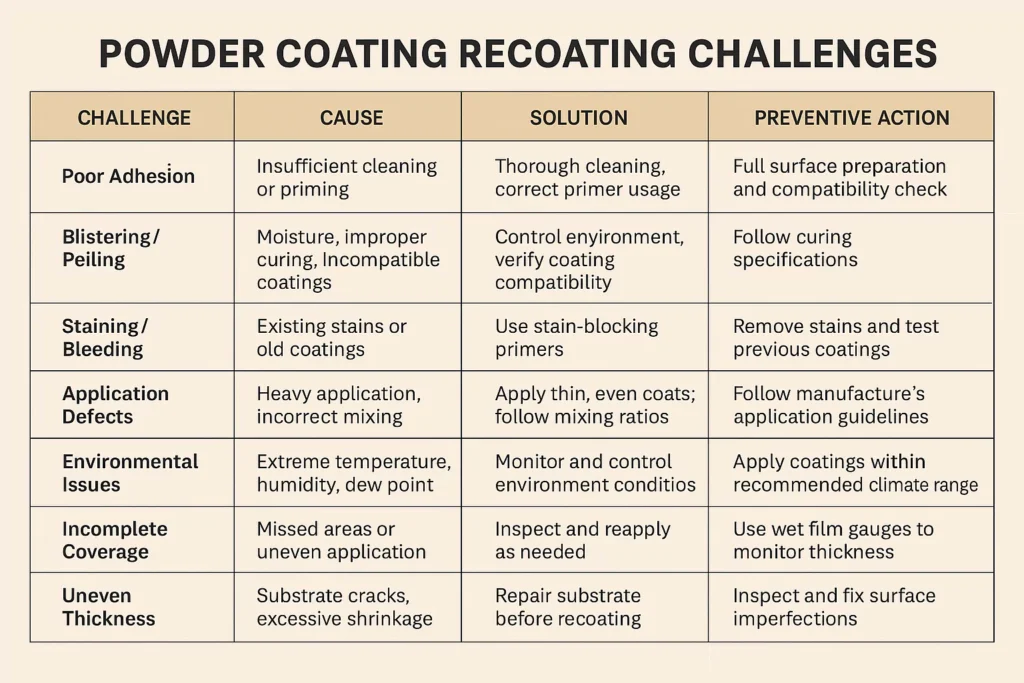
Common Recoating Challenges and Their Solutions