Table of Contents
- 1. What Is the Projected Growth and Outlook for the Powder Coating Market in 2025 and Beyond?
- 2. How Do Sustainability Trends and Environmental Regulations Influence the Powder Coating Industry?
- 3. Which Technological Innovations Are Shaping the Future of Powder Coatings?
- 4. What Are the Evolving Customer Expectations in the Powder Coating Industry?
- 5. What Are the Key Challenges and Opportunities in the Powder Coating Market?
- 6. How Is the Powder Coating Market Segmented and What Are Its Emerging Applications?
- 7. What Strategic Actions Should Powder Coating Industry Stakeholders Take to Stay Competitive?
What Is the Projected Growth and Outlook for the Powder Coating Market in 2025 and Beyond?
The powder coating market enters 2025 with strong momentum. Analysts project a compound annual growth rate (CAGR) ranging from 5.46% to 6.78% through the forecast period. This growth reflects expanding industrial applications, technological innovations, and tightening environmental regulations.
Key industries drive demand for powder coatings. Automotive manufacturers adopt powder coatings for durability, corrosion resistance, and uniform finishes. The construction sector applies these coatings to metal structures, facades, and fixtures due to their longevity and weather resistance. Consumer goods producers increasingly use powder coatings on appliances, furniture, and electronics to meet both aesthetic and functional standards.
Technological advancements support market expansion. New formulations enable thinner coatings with improved adhesion, scratch resistance, and faster curing times. Low-temperature cure powders reduce energy consumption, aligning with sustainability goals. Additionally, innovations like antimicrobial powder coatings address rising hygiene concerns in healthcare and public spaces.
Environmental policies significantly influence market dynamics. Governments enforce stricter limits on volatile organic compounds (VOCs), favouring powder coatings over traditional liquid paints. Powder coatings release negligible VOCs, contributing to cleaner production processes and safer work environments.
How Do Sustainability Trends and Environmental Regulations Influence the Powder Coating Industry?
Powder coating aligns closely with modern sustainability targets and environmental regulations. Its solvent-free composition results in negligible volatile organic compound (VOC) emissions, supporting global air quality standards.
Unlike liquid paints, powder coatings generate minimal hazardous waste. Overspray is recoverable and reusable, which reduces raw material consumption and waste disposal challenges. This closed-loop process contributes to resource efficiency and environmental protection.
Durability is a key advantage. Powder-coated surfaces resist corrosion, UV degradation, and physical damage, extending product lifespans. Fewer recoating cycles translate into lower raw material demand and energy use across product lifecycles.
Controlled application environments optimise resource use. Automated systems ensure uniform coatings, minimise emissions, and protect worker health. These systems also improve coating efficiency and reduce environmental burdens.
Leading manufacturers invest in sustainable innovations. Firms like AkzoNobel, Sherwin-Williams, and PPG Industries develop low-cure, energy-efficient formulations that meet carbon reduction goals.
Strict regulatory frameworks such as the EU’s REACH directive and the US EPA’s Clean Air Act drive adoption. Compliance with these laws ensures minimal ecological impact while maintaining performance.
Key Environmental Benefits of Powder Coating
Attribute | Description | Environmental Impact |
VOC Emissions | Solvent-free formulation | Negligible air pollution |
Waste Generation | Recoverable overspray | Reduced hazardous waste |
Durability | Resistance to wear and corrosion | Extended product lifespan |
Energy Efficiency | Low-cure technology | Lower energy consumption |
Regulatory Compliance | Meets REACH and EPA standards | Enhanced environmental performance |
Which Technological Innovations Are Shaping the Future of Powder Coatings?
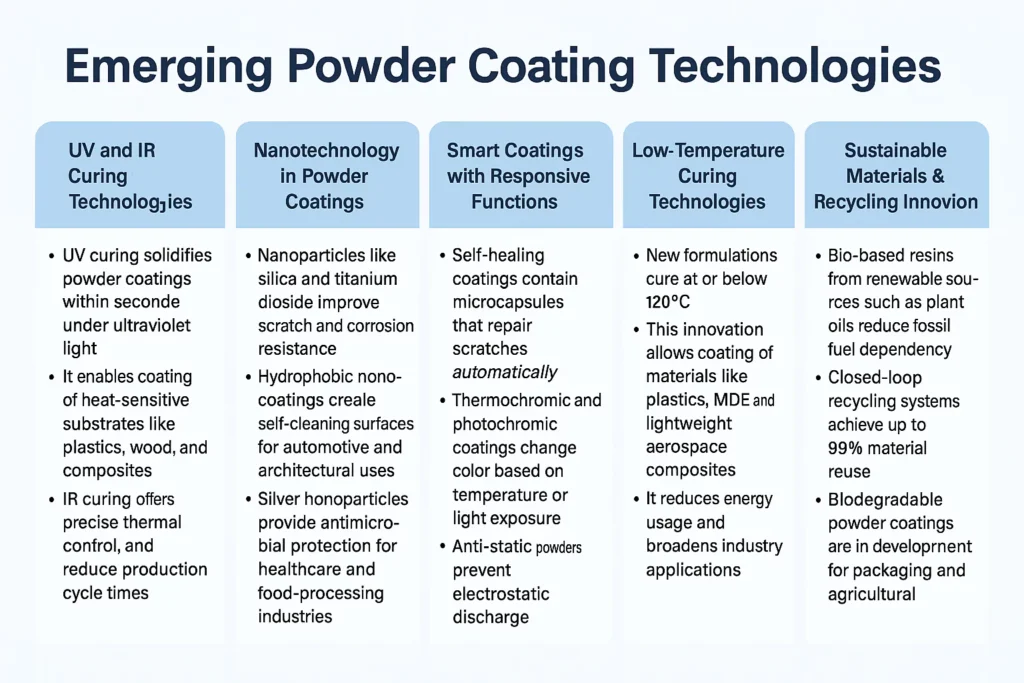
Technological breakthroughs are redefining the powder coating industry, enhancing efficiency, sustainability, and application diversity. The key advancements include:
- UV and IR Curing Technologies
- UV curing solidifies powder coatings within seconds under ultraviolet light.
- It enables coating of heat-sensitive substrates like plastics, wood, and composites.
- IR curing offers precise thermal control, minimising material stress.
- Both methods lower energy consumption and reduce production cycle times.
- Nanotechnology in Powder Coatings
- Nanoparticles like silica and titanium dioxide improve scratch and corrosion resistance.
- Hydrophobic nano-coatings create self-cleaning surfaces for automotive and architectural uses.
- Silver nanoparticles provide antimicrobial protection for healthcare and food-processing industries.
- Companies like AkzoNobel and BASF lead in commercialising nano-coating technologies.
- Smart Coatings with Responsive Functions
- Self-healing coatings contain microcapsules that repair scratches automatically.
- Thermochromic and photochromic coatings change colour based on temperature or light exposure.
- Anti-static powders prevent electrostatic discharge, protecting sensitive electronic components.
- Low-Temperature Curing Technologies
- New formulations cure at or below 120°C.
- This innovation allows coating of materials like plastics, MDF, and lightweight aerospace composites.
- It reduces energy usage and broadens industry applications.
- Sustainable Materials and Recycling Innovations
- Bio-based resins from renewable sources such as plant oils reduce fossil fuel dependency.
- Closed-loop recycling systems achieve up to 99% material reuse.
- Biodegradable powder coatings are in development for packaging and agricultural applications.
Advancements in Technology Driving the Future of Powder Coating
What Are the Evolving Customer Expectations in the Powder Coating Industry?
Customer expectations in the powder coating sector are changing rapidly, demanding greater functionality, sustainability, and operational efficiency alongside traditional performance standards.
- Increased Functional Demands
- Clients seek advanced coatings with self-healing, antimicrobial, and anti-static properties.
- Industries such as healthcare, electronics, and automotive require coatings that offer both protection and enhanced functionality.
- Smart coatings that respond to environmental triggers like temperature and light are gaining popularity in consumer electronics and architectural applications.
- Sustainability as a Core Expectation
- Customers prioritise eco-friendly solutions with minimal environmental impact.
- Powder coatings meet these demands through low VOC emissions, energy-efficient curing, and recyclable overspray recovery.
- The use of bio-based resins and biodegradable powders aligns with growing global sustainability goals.
- Faster Turnaround Times
- Shorter production cycles and quicker curing processes, enabled by UV and IR curing technologies, meet customer demands for rapid delivery.
- Automated application systems enhance precision, reduce errors, and ensure consistent quality.
- Durability and Aesthetic Excellence
- Clients continue to demand coatings that resist corrosion, UV degradation, and physical damage.
- A wide range of colours, textures, and finishes offers customisation for various industries, from luxury furniture to industrial equipment.
- Supply Chain Reliability
- Businesses must ensure stable raw material sourcing and efficient logistics.
- Reliable supply chains support consistent product availability, maintaining client trust and operational continuity.
What Are the Key Challenges and Opportunities in the Powder Coating Market?
The powder coating industry faces several challenges alongside significant growth opportunities.
- High Initial Investment
- Setting up powder coating facilities requires costly equipment such as spray booths, curing ovens, and recovery systems.
- Small and medium enterprises may struggle with capital expenditure, limiting market entry.
- Need for Specialised Expertise
- Operators must possess technical knowledge in material properties, application techniques, and curing processes.
- Incorrect application or curing can result in coating defects, reducing product quality and increasing waste.
- Curing and Adhesion Issues
- Some substrates present difficulties in achieving optimal adhesion and curing.
- Heat-sensitive materials require precise temperature control to avoid warping or incomplete curing.
Despite these hurdles, the sector offers substantial opportunities:
- Technological Innovation
- Advancements in low-temperature curing and nanotechnology expand application possibilities.
- Smart coatings open new markets in consumer electronics, aerospace, and healthcare.
- Sustainability Focus
- Growing environmental regulations favour powder coatings due to their low VOC emissions and high material utilisation rates.
- Bio-based and recyclable powders enhance market appeal.
How Is the Powder Coating Market Segmented and What Are Its Emerging Applications?
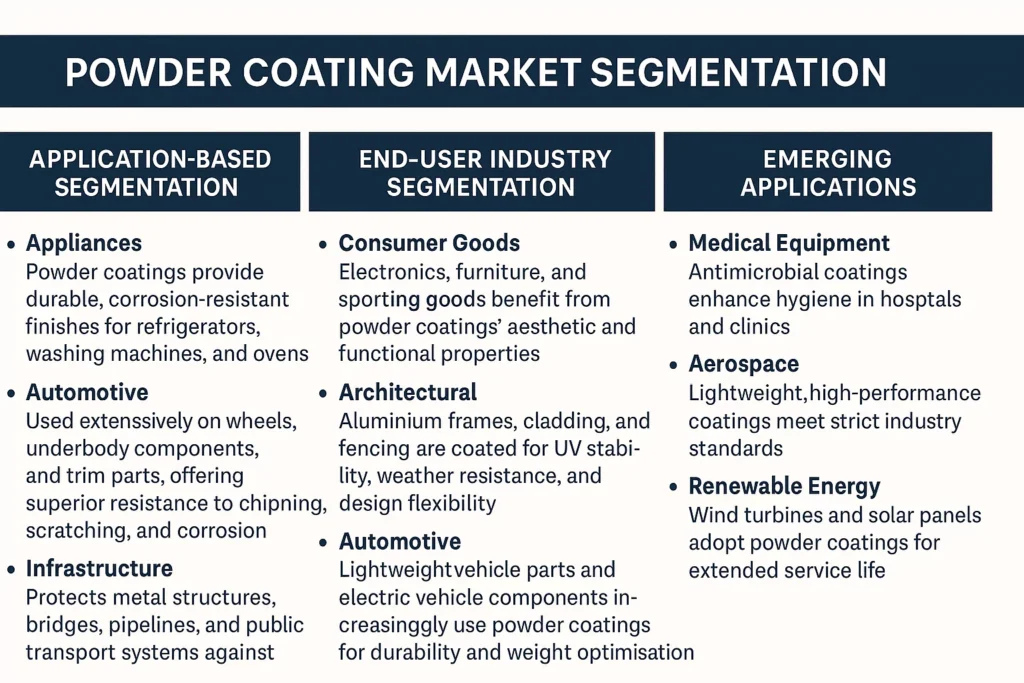
The powder coatings market exhibits diverse segmentation across applications and end-user industries, reflecting its growing versatility.
- Application-Based Segmentation
- Appliances: Powder coatings provide durable, corrosion-resistant finishes for refrigerators, washing machines, and ovens.
- Automotive: Used extensively on wheels, underbody components, and trim parts, offering superior resistance to chipping, scratching, and corrosion.
- Infrastructure: Protects metal structures, bridges, pipelines, and public transport systems against environmental damage.
- General Industrial: Applied to agricultural equipment, machinery, and industrial shelving for longevity and protection.
- End-User Industry Segmentation
- Consumer Goods: Electronics, furniture, and sporting goods benefit from powder coatings’ aesthetic and functional properties.
- Architectural: Aluminium frames, cladding, and fencing are coated for UV stability, weather resistance, and design flexibility.
- Automotive: Lightweight vehicle parts and electric vehicle components increasingly use powder coatings for durability and weight optimisation.
- Emerging Applications
- Medical Equipment: Antimicrobial coatings enhance hygiene in hospitals and clinics.
- Aerospace: Lightweight, high-performance coatings meet strict industry standards.
- Renewable Energy: Wind turbines and solar panels adopt powder coatings for extended service life.
Powder Coating Market Segments and Emerging Uses
What Strategic Actions Should Powder Coating Industry Stakeholders Take to Stay Competitive?
Industry stakeholders must adopt targeted strategies to maintain competitiveness and meet shifting market expectations in the powder coating sector.
Key Strategic Actions
Strategic Area | Recommended Actions | Expected Outcomes |
Sustainability | – Source bio-based resins and recyclable powders – Use closed-loop recovery systems – Adopt energy-efficient curing | – Lower environmental impact – Compliance with regulations – Enhanced brand reputation |
Digital Technologies | – Integrate AI and ML for process monitoring – Use predictive maintenance – Employ digital twins for simulations | – Improved quality control – Reduced downtime – Optimised formulations |
Value Chain Collaboration | – Partner with suppliers, manufacturers, and end-users – Share data across the chain – Engage in joint R&D projects | – Streamlined operations – Faster innovation – Increased transparency |
Workforce Development | – Train staff in application techniques and digital systems – Build multidisciplinary teams | – Skilled workforce – Enhanced operational capabilities |
By executing these strategies, industry players can improve efficiency, foster innovation, and meet evolving customer demands.