Table of Contents
- 1. When Did Powder Coating First Emerge as a Finishing Method?
- 2. How Did Electrostatic Spraying Transform Powder Coating in the 1960s–70s?
- 3. How Did Environmental Regulations Shape Powder Coating from the 1970s to 1990s?
- 4. What Were the Key Technological Breakthroughs in Powder Coating During the 1990s–2000s?
- 5. How Did Powder Coating Become an Industrial Standard Worldwide?
- 6. What Defines Powder Coating Trends and Innovations in the 21st Century?
- 7. What Are the Major Milestones in Powder Coating History?
When Did Powder Coating First Emerge as a Finishing Method?
I first came across powder coating’s roots in the 1940s, when manufacturers tried using flame-sprayed plastic powders on metal. It worked, but the coatings were rough, and the method wasn’t safe. In the 1950s, I learnt how Dr Erwin Gemmer changed the game. He built the fluidised bed process, where powder floated in air and stuck to heated parts. This gave us a proper dry coating method that worked better than spraying.
Later, in 1960, Pieter de Lange introduced a smart fix. He charged powder particles so they’d cling better to metal. His electrostatic application made powder coating more reliable and efficient. I’ve seen how changes in VOC rules pushed industries to adopt cleaner finishes. Powder coating grew because it cut out solvents and met new environmental regulations.
How Did Electrostatic Spraying Transform Powder Coating in the 1960s–70s?
In the 1960s, I saw powder coating change completely. The old fluidised bed system was bulky and wasteful. Then came electrostatic spray deposition (ESD), and everything shifted. Using charged spray guns, we could now apply powder with precision and control.
This step improved application accuracy and made the process much cleaner. Overspray could be collected and reused. That boosted dry coating development while keeping waste low. It also matched the rising environmental regulation coatings that aimed to cut down on solvent use.
Pieter de Lange helped guide this shift, adapting liquid paint tools for powder use. That move pushed the evolution of powder coating forward fast. ESD gave us better adhesion before curing, more even coats, and quicker cycle times thanks to advancements in powder curing. When VOC regulations started, industries needed a cleaner process. ESD made powder coating a top choice
How Did Environmental Regulations Shape Powder Coating from the 1970s to 1990s?
In the 1970s, I saw powder coating gain serious ground as new environmental laws came into force. These changes pushed industries to find cleaner, safer ways to finish products.
- Clean Air Act (1970)
I remember when this law raised the alarm about air pollution. It targeted industries using solvent-based coatings that released harmful VOCs. - VOC regulations history
Solvent paints came under fire. They polluted the air and created health risks. Powder coating offered a dry, solvent-free option that met new environmental regulations for coatings. - Rise of powder as an eco-solution
Since powder didn’t need solvents, it quickly became the cleaner alternative. I saw more companies adopt it to avoid fines and cut waste. - Evolution of powder coating technology
This shift led to better electrostatic application methods, improved recovery systems, and faster powder curing advancements. - Plastic powder spray methods replaced solvents
We moved from old wet systems to dry coating development that helped industries meet tight regulations without compromising finish quality.
Environmental Regulations Shape Powder Coating (1970s-1990s)
What Were the Key Technological Breakthroughs in Powder Coating During the 1990s–2000s?
In the 1990s and early 2000s, I saw powder coating go far beyond metal. New ideas and tools helped it reach new materials and improve efficiency across industries.
- Thermoset Material Development
We worked with better thermoset resins that gave stronger finishes. UV-cured powders let us coat heat-sensitive plastics like MDF without damage. - Advanced Curing Systems
Infrared and UV ovens sped up curing and saved energy. These upgrades improved powder curing speed and made it easier to meet VOC regulation targets. - Smarter Application Guns
New electrostatic spray guns gave tighter control and better coverage. It became easier to coat detailed shapes and reduce waste. - Dry Coating on Plastics and Glass
Plastic powder spray methods were refined so we could coat non-metal surfaces. Conductive primers and surface pre-treatment helped us coat plastic reliably. - Ongoing Evolution
These years shaped the modern phase in the history of powder coating, with big steps in both process innovation and material versatility.
How Did Powder Coating Become an Industrial Standard Worldwide?
Powder coating became a global industrial standard through innovation, regulation, and adoption by early leader regions like the EU, USA, and Japan. Each played a role in scaling the technology through environmental legislation, manufacturing efficiency, and technological refinement.
- Europe adopted powder coating early in response to VOC regulations history, particularly through German automotive and appliance manufacturers.
- The USA followed with strong environmental regulation on coatings under the Clean Air Act, which pushed industries away from solvent-based systems.
- Japan led precision improvements, integrating powder coating into electronics and fine metal finishing.
Key sectors drove this global standardisation:
- Automotive: Used dry coating development for underbody and engine parts.
- Appliance and furniture: Applied plastic powder spray methods for durable, decorative finishes.
- Architecture and infrastructure: Used advancements in powder curing to meet structural and aesthetic demands.
The history of powder coating began with Dr. Erwin Gemmer in the 1950s. The evolution of powder coating accelerated in the 1960s with the electrostatic application history and culminated in global industrial uptake by the 1990s.
What Defines Powder Coating Trends and Innovations in the 21st Century?
I’ve seen powder coating shift towards smarter, cleaner, and more adaptable technologies in recent years. Low-temperature curing powders now allow me to coat heat-sensitive plastics without damage, meeting tighter VOC regulations and saving energy. I’ve worked with antimicrobial finishes too, especially useful in healthcare and food industries. With growing pressure from environmental regulation on coatings, I prefer dry coating methods that minimise waste and eliminate solvents.
The evolution of powder coating continues as I integrate robotics, sensors, and digital controls into production lines. Electrostatic application, a method rooted in the history of powder coating, remains central but has advanced alongside AI-powered systems. I’m also experimenting with plastic powder spray methods using UV and IR curing, key advancements in powder curing, to finish 3D-printed parts efficiently. As sustainability and performance demands rise, innovation is no longer optional. It defines my process.
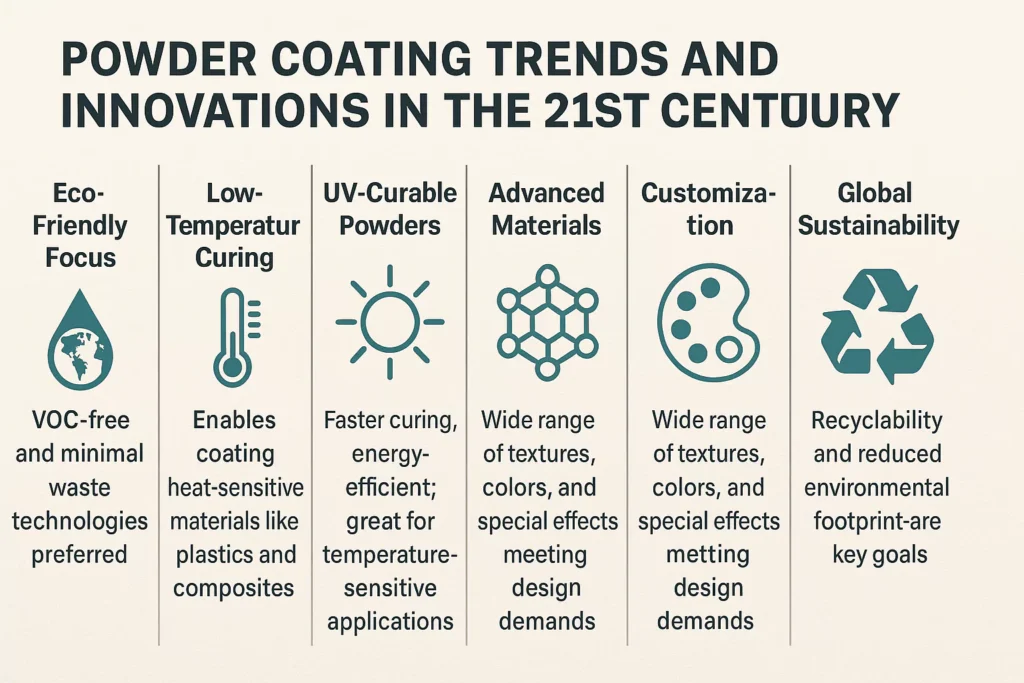
Powder Coating Trends and Innovations (21st Century)
What Are the Major Milestones in Powder Coating History?
The powder coating timeline stretches from post-war industrial research to today’s sustainability-led innovation. Powder coating was invented around 1945 by Daniel Gustin, who patented a process using heat and electrostatics. In 1953, Dr. Erwin Gemmer revolutionised the method by introducing fluidised bed technology. His technique helped develop the first dry coating methods for industrial use.
In the 1960s, electrostatic application techniques were adapted from other industries, enabling more uniform spray finishes. VOC regulations, introduced in the 1970s, shifted demand from solvent-based coatings to powder alternatives. Curing technology progressed through infrared and UV systems, allowing powder to be used on plastic substrates and heat-sensitive materials.
Milestones like the development of plastic powder spray methods and stricter environmental coating regulations in the 1980s and 1990s shaped today’s industry. Modern innovations focus on low-temperature curing and sustainability, confirming powder coating’s evolution from niche to global industrial standard.
Timeline of Key Milestones in Powder Coating
Year | Milestone |
1945 | Powder coating was patented by Daniel Gustin |
1953–1955 | Dr. Erwin Gemmer patents the fluidised bed coating method |
1960s | Electrostatic spray adapted for powder coating |
1970s | VOC regulations introduced, accelerating powder coating adoption |
1980s | Automated spray systems improve dry coating consistency |
1990s | Environmental regulation, coatings, and reclaimable overspray technology |
2000s | Plastic powder spray methods improve with lower curing temperatures |
2010s | Advancements in powder curing using UV and IR systems |
2020s | Focus on sustainability, antimicrobial finishes, and smart factory usage |