Table of Contents
- 1. Why Powder Coat Non-Metal Surfaces?
- 2. What Automotive Parts Are Commonly Powder Coated?
- 3. How Should Automotive Parts Be Prepared for Powder Coating?
- 4. How Is the Powder Coating Process Adapted for Automotive Applications?
- 5. What Are the Performance Benefits of Powder Coating Automotive Parts?
- 6. What Industry Standards and Certifications Apply to Automotive Powder Coating?
- 7. What Are the Main Challenges in Automotive Powder Coating and How Are They Solved?
Why Powder Coat Non-Metal Surfaces?
Powder coating non-metallic materials provides a protective, decorative, and cost-efficient alternative to traditional painting. Although metal remains the primary substrate, modern formulations now support various non-metals like plastics, wood, MDF, and glass.
Key Reasons to Powder Coat Non-Metals
- Improves Durability
- Creates a hard, cross-linked finish resistant to scratches, UV rays, and chemicals
- Ideal for items exposed to frequent use or outdoor environments
- Expands Finish Options
- Offers matte, gloss, textured, metallic, and custom colour finishes
- Supports aesthetic consistency across mixed-material products
- Enhances Environmental Performance
- Contains no VOCs or solvents; meets EU sustainability standards
- Nearly 100% powder utilisation; reduces material waste
- Increases Cost Efficiency
- Reduces rework, overspray loss, and manual labour
- Speeds up production via faster cure times, especially with IR ovens
- Supports Multiple Substrates
- Applicable to MDF, hardwood, engineered plastics, and glass
- Used in automotive interiors, kitchen cabinetry, display fixtures, and signage
Technical Considerations for Non-Metals
- Curing Temperatures
- Substrate must withstand 120–200°C curing heat without deformation
- Surface Preparation
- Requires proper cleaning, degassing, or priming for optimal adhesion
- Adhesion Enhancers
- May need corona treatment, chemical etching, or adhesion promoters
What Automotive Parts Are Commonly Powder Coated?
Powder coating is a preferred finishing method for many automotive components due to its resistance to corrosion, chemicals, and abrasion. It also offers a wide range of finishes, making it ideal for both functional protection and aesthetic enhancement.
Below is a structured overview of commonly powder-coated automotive components:
Component Category | Examples | Purpose of Powder Coating |
Wheels & Rims | Alloy wheels, steel rims | Protection from UV, brake dust, road debris, and custom finish |
Engine Components | Valve covers, oil pans, engine blocks, timing covers | Heat resistance, oil protection, improved under-hood appearance |
Suspension Parts | Coil springs, shock absorbers, sway bars, control arms | Chip resistance, corrosion protection, extended part lifespan |
Brake System | Brake calipers, brackets | High heat durability, colour stability, reduced corrosion |
Chassis & Frames | Subframes, roll cages, vehicle frames, crossmembers | Rust prevention, structural durability, stone impact resistance |
Exterior Accessories | Bumpers, grilles, door handles, side steps, mirrors | Scratch resistance, weatherproofing, enhanced appearance |
Interior & Trim Pieces | Dashboard brackets, interior handles, trim elements | Uniform finish, customisation, fade resistance |
Utility Add-ons | Truck bed rails, roof racks, kickstands, battery trays, fuel filter holders | Abrasion protection, chemical resistance, cleaner visual finish |
Each of these components is powder-coated not just for durability but also for consistent colour matching and premium surface aesthetics.
How Should Automotive Parts Be Prepared for Powder Coating?
Proper surface preparation is essential for strong powder coating adhesion, long-term durability, and a defect-free finish. Automotive components undergo a multi-step preparation process tailored to their material, exposure level, and geometry.
Key Surface Preparation Steps
- Disassembly
- Remove non-coatable parts like rubber, plastic, or electronic components
- Isolate the component to ensure full surface exposure during coating
- Degreasing & Cleaning
- Clean oil, grease, rust, and road debris using degreasers, parts washers, or solvent baths
- Ensure the substrate is contaminant-free for optimal electrostatic bonding
- Pre-Baking (Optional)
- Pre-bake porous metals (e.g. cast aluminium, iron) at 200°C to outgas trapped oils
- Prevents bubbling or coating failures during final curing
- Abrasive Blasting or Sanding
- Use sandblasting or bead blasting to remove rust, old paint, and scale
- Creates an anchor profile for powder to grip securely
- For smaller areas, hand sanding with 120–180 grit achieves a similar effect
- Chemical Pretreatment
- Apply phosphate conversion coatings for corrosion resistance and improved bonding
- Rinse and dry thoroughly before coating
- Masking
- Protect threads, mating surfaces, or heat-sensitive zones with high-temp tape or plugs
- Ensure no powder contaminates critical mechanical or electrical areas
- Drying
- Fully dry the part before powder application to prevent moisture entrapment
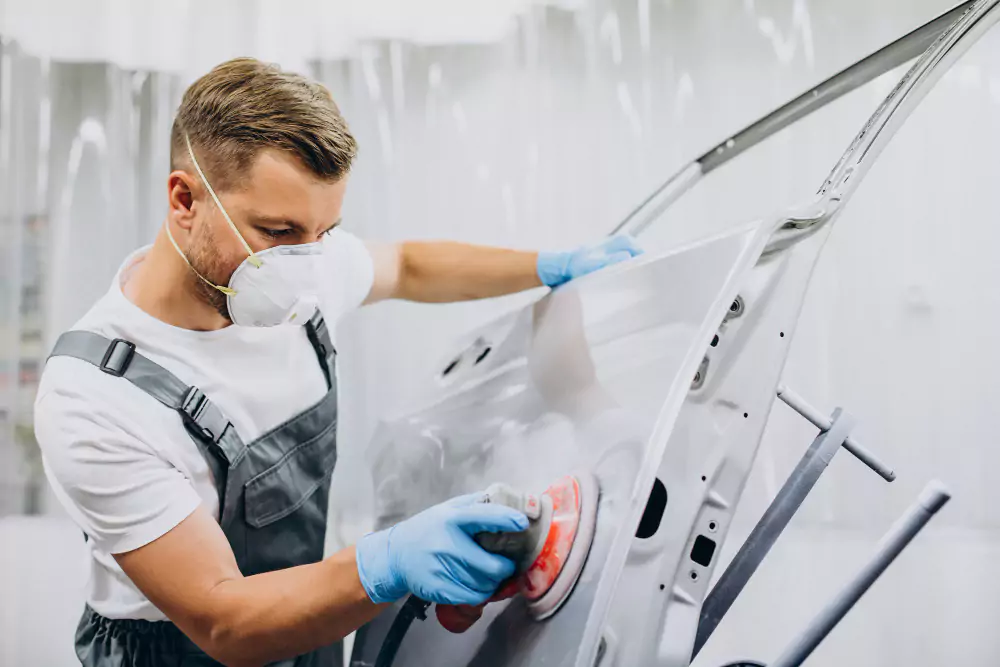
Automotive Parts Preparation Process
How Is the Powder Coating Process Adapted for Automotive Applications?
The powder coating process for automotive parts is adapted to meet specific durability, precision, and heat tolerance requirements. Vehicle components face extreme conditions, so adjustments in application, curing, and material selection ensure performance and longevity.
Key Automotive-Specific Adaptations
- Advanced Powder Formulations
- Automotive powders are engineered for heat resistance, chemical durability, and impact toughness.
- Polyester-epoxy hybrids are often used for under-hood parts, while TGIC-free polyesters suit exterior trim.
- Electrostatic Precision Application
- High-precision spray systems ensure even coverage on complex geometries like wheels, grilles, and brake callipers.
- Grounding systems are calibrated to ensure consistent electrostatic adhesion on curved or hidden surfaces.
- Curing Modifications
- Cure profiles are adjusted based on substrate mass and type.
- Lightweight aluminium parts cure faster; heavy steel frames require extended time at 180–200°C.
- Infrared (IR) and convection ovens are used selectively to optimise energy use and cure depth.
- Multistage Coating Systems
- Automotive applications may involve primer coats (anti-corrosion), colour layers, and clear topcoats for gloss and UV stability.
- Automation and Quality Control
- Robotic arms and in-line inspection systems are used for repeatability and coating thickness consistency.
What Are the Performance Benefits of Powder Coating Automotive Parts?
Powder coating provides superior protection and longevity for automotive components compared to conventional liquid paint. Its physical properties and application method deliver enhanced surface performance, both functionally and visually.
Key Performance Advantages
Benefit | Description | Applications |
Durability | Resistant to chips, scratches, abrasion, and daily wear | Bumpers, wheels, suspension arms |
Corrosion Resistance | Forms a barrier against water, salt, and oxygen to prevent rust | Undercarriage, chassis, brake components |
Chemical Resistance | Protects against oil, fuel, brake fluid, and cleaning agents | Engine bays, brake calipers, underbody panels |
Heat Resistance | Specialised coatings withstand 200–600°C without degrading | Exhaust systems, manifolds, turbo housings |
UV & Weather Protection | Prevents fading, chalking, and degradation from sunlight and harsh environments | Body trim, roof racks, exterior accessories |
Uniform Finish | Electrostatic spray provides an even coat without drips or brush marks | All visible parts requiring aesthetic appeal |
Aesthetic Variety | Available in gloss, matte, satin, metallic, candy, and textured finishes | Custom wheels, grilles, trim elements |
Material Versatility | Suitable for metals, some plastics, and fibreglass | Interior trim, lightweight composite panels |
Eco-Friendly Application | Contains no VOCs, allows for powder recovery, and produces less waste | All coating operations within environmentally regulated zones |
Cost-Efficiency | Longer lifespan reduces need for repainting or replacements | Fleet vehicles, high-usage parts, custom builds |
What Industry Standards and Certifications Apply to Automotive Powder Coating?
Automotive powder coating must meet rigorous standards to ensure product quality, durability, and environmental compliance. Industry certifications validate a coater’s ability to deliver consistent, high-performance finishes that align with manufacturer and regulatory expectations.
Key Certifications and Standards
Standard/Certification | Purpose | Applies To |
ISO 9001 | Ensures a structured quality management system and consistent processes | All powder coating operations |
ISO 14001 | Establishes environmental management systems for minimising ecological impact | Environmentally compliant coaters |
IATF 16949:2016 | Automotive-specific quality standard aligning with ISO 9001, includes defect prevention | OEM and Tier 1 suppliers |
OEM-Specific Standards | Include requirements from JLR, Tesla, VW/Audi, BMW for adhesion, thickness, corrosion testing | Supplier-specific contracts and audits |
BS EN 12206 | Governs powder coating on architectural aluminium, relevant for trim and bodywork | UK-based applications involving aluminium components |
Qualicoat | Certifies the quality of coated aluminium for architectural and transport applications | Exterior automotive trim and structural panels |
PCI Certification | Independent evaluation by the Powder Coating Institute on process capability | Benchmark for general powder coating excellence |
Quality Assurance Tests
- Visual Inspection:- Detects surface defects, uneven coverage, or contamination
- Adhesion Testing:- Verifies bond strength between coating and substrate
- Coating Thickness Measurement:- Confirms film build complies with specifications
- Salt Spray Testing:- Simulates corrosion exposure to assess resistance
These certifications and tests ensure compliance, boost supplier credibility, and help meet OEM production standards
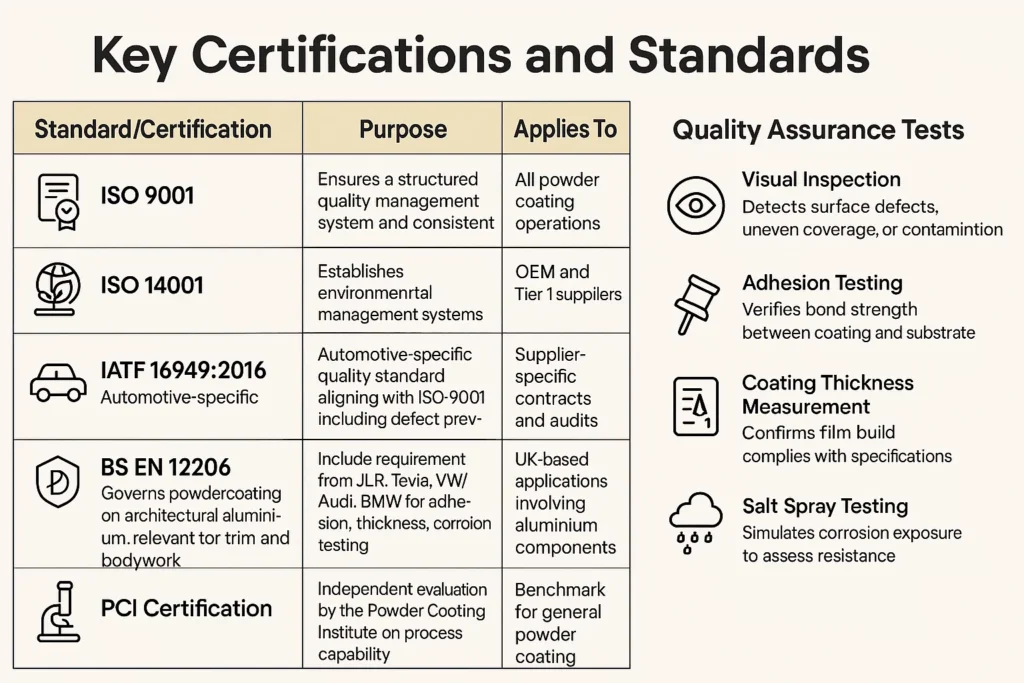
Automotive Powder Coating Must Meet Industry Standards and Certification Requirements
What Are the Main Challenges in Automotive Powder Coating and How Are They Solved?
While powder coating offers major advantages in automotive manufacturing, it also presents several technical and operational challenges. These issues can impact coating performance, finish quality, and production efficiency. However, targeted solutions and innovations have significantly reduced failure rates and improved process reliability.
Common Challenges and Practical Solutions
Challenge | Description | Solution |
Adhesion Failures | Peeling or chipping due to poor surface preparation or incompatible substrates | Apply thorough pre-treatment including degreasing, blasting, and phosphate conversion |
Heat Sensitivity | Some substrates (e.g. plastics) deform at standard curing temperatures | Use low-bake or UV-curable powder coatings |
Outgassing Issues | Air or oils escape during curing, creating bubbles or blisters | Pre-bake porous substrates like cast aluminium to release trapped gases |
“Orange Peel” Texture | Uneven surface caused by improper application or powder flow | Adjust powder flow rate, gun distance, and curing time; use flow-enhancing formulations |
Colour Matching Difficulties | Precise colour reproduction can be limited with powders | Use digital colour matching tools and consistent batch controls |
Equipment Costs | High initial investment can deter smaller operations | Lease-to-own schemes, modular systems, or outsourcing to certified providers |
Contaminated Surfaces | Dirt, oil, or rust lowers coating adhesion and visual quality | Enforce strict cleaning protocols and environment-controlled application zones |
Health Hazards | Inhalation or skin contact with powder can cause health issues | Use PPE, local exhaust ventilation, and training to minimise exposure risks |