Table of Contents
- 1. Why Powder Coat Non-Metal Surfaces?
- 2. Which Non-Metal Materials Can Be Powder Coated Successfully?
- 3. How Should Non-Metal Surfaces Be Prepared Before Powder Coating?
- 4. What Powder Application Methods Work Best for Non-Metal Substrates?
- 5. What Factors Affect the Curing of Powder Coating on Non-Metals?
- 6. How Durable and High-Performing Are Powder Coatings on Non-Metals?
- 7. Where Are Powder-Coated Non-Metal Materials Used in Industry?
Why Powder Coat Non-Metal Surfaces?
Powder coating enhances the performance and longevity of non-metal surfaces such as wood, plastics, and glass. It forms a hardened, uniform finish that resists wear, corrosion, and environmental damage.
Key Benefits of Powder Coating Non-Metallic Materials:
- Improves Durability: Forms a solid, impact-resistant layer that withstands scratches, abrasion, and chips.
- Enhances Surface Protection: Shields against UV rays, moisture, chemicals, and corrosion, especially important for outdoor or high-use applications.
- Supports a Wide Range of Materials: Suitable for plastics (like polycarbonate), MDF, HDF, wood composites, and glass using advanced pre-treatment and curing methods.
- Enables Custom Coatings: Powders can be modified to resist UV degradation, chemical exposure, or temperature fluctuations for niche applications.
- Reduces Environmental Impact: Free from solvents and VOCs; overspray can be recovered and reused, reducing waste and emissions.
- Offers Cost Efficiency: Lower operational costs than liquid paint over time; requires fewer recoats and minimises waste in large-scale production.
- Used Across Multiple Industries: Found in furniture, electronics, automotive interiors, cabinetry, and architectural installations where aesthetics and function intersect.
- Achieves Superior Finish Quality: Results in a smoother, more consistent appearance without brush marks or sagging typical of wet paints.
Which Non-Metal Materials Can Be Powder Coated Successfully?
Powder coating is no longer limited to metal surfaces. With advances in formulation and curing technologies, various non-metallic substrates are now compatible with powder coating. The key requirement is thermal resistance, typically above 130°C, to allow proper adhesion and curing.
Common Non-Metal Substrates for Powder Coating:
- Medium Density Fibreboard (MDF)
MDF is widely used in furniture and interior design. Its uniform surface and density make it ideal for powder coating using low-cure powders or infrared (IR) curing. - Wood and Wood Composites
Natural wood and engineered boards can be coated if the moisture content is controlled. Pre-treatment and conductive priming improve powder adhesion on non-conductive surfaces. - Plastics
Thermoplastics like polyamide (PA), polycarbonate (PC), and TIGITAL thermosets used in 3D printing are powder-coatable. The substrate must endure the curing process, often achieved with UV or low-bake systems. - Composites
Carbon fibre-reinforced polymers (CFRP) and other high-performance composites used in aerospace and automotive sectors are compatible with adapted powder technologies. - Glass
Coatable with electrostatic or tribo-charging methods. Often used in decorative panels and lighting elements, where colour and finish uniformity are critical. - Other Substrates
Materials such as fibreglass, ceramics, and even drywall can receive powder coating with special surface treatment and tailored curing processes.
How Should Non-Metal Surfaces Be Prepared Before Powder Coating?
Effective surface preparation is essential for successful powder coating on non-metal substrates. These materials, such as plastics, wood, glass, and composites, require tailored pre-treatment to ensure proper adhesion, conductivity, and finish quality.
Key Steps in Preparing Non-Metal Surfaces:
- Cleaning the Surface
- Washing: Use clean water or mild detergent to remove dust and dirt.
- Degreasing: Apply an alkaline or solvent-based cleaner to eliminate oils and grease.
- Mechanical Preparation
- Abrasive Methods: Use sandpaper or blasting to increase surface roughness and remove old coatings.
- Sanding: Especially important for MDF and wood to level surface fibres.
- Chemical Cleaning and Rinsing
- Chemical Agents: Select alkaline, neutral, or acidic cleaners based on substrate compatibility.
- Rinsing: Always rinse thoroughly to avoid residue that may interfere with adhesion.
- Enhancing Surface Adhesion
- Conversion Coatings: Useful on composite materials to improve bond strength.
- Surface Roughness: Increased micro-texture improves powder hold.
- Improving Conductivity
- Conductive Primers: Apply to non-conductive materials like plastics or glass to ensure proper electrostatic attraction during powder application.
- Corona/Flame Treatment: Alters surface energy to improve adhesion and charge acceptance.
- Drying and Masking
- Ensure full drying before coating to prevent defects.
- Mask sensitive areas that must remain uncoated.
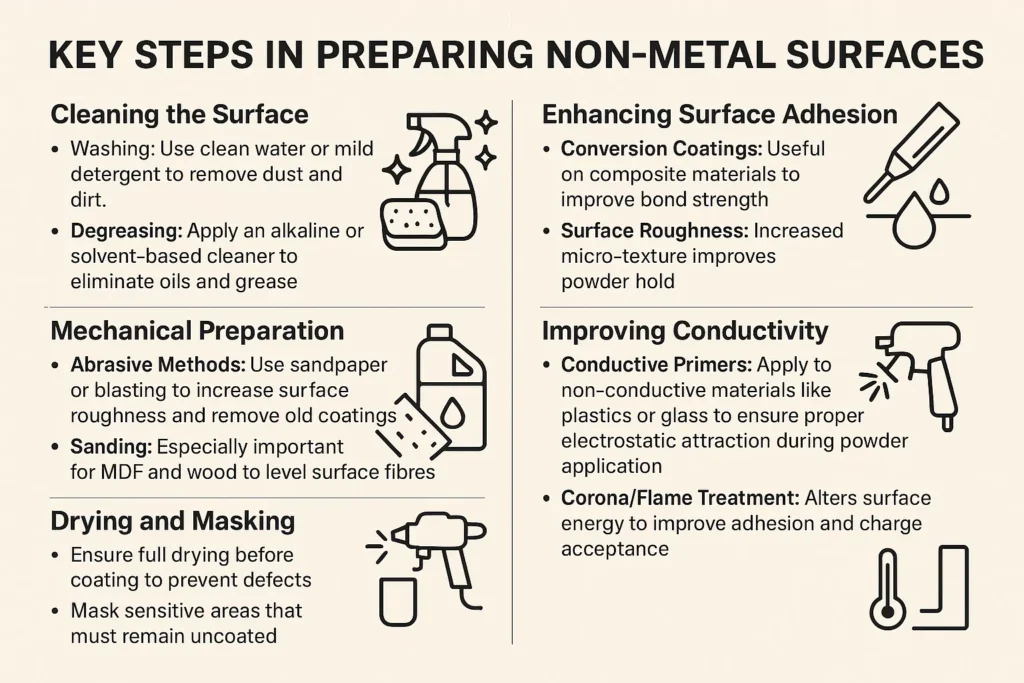
Preparing Non-Metal Surfaces for Powder Coating
What Powder Application Methods Work Best for Non-Metal Substrates?
Powder application on non-metal substrates requires modified processes to accommodate thermal sensitivity, geometry, and surface conductivity. Two key powder coating techniques, Electrostatic Deposition (ESD) and Fluidized Bed Coating, are adapted for different substrates and production scales.
1. Electrostatic Deposition (ESD)
- Powder Application: Powder is sprayed through an electrostatic gun, charging particles to attract them to grounded parts.
- Spray System Components
- Powder Spray Booth: Filters air and collects overspray.
- Powder Feeder: Distributes powder to the spray gun.
- Electrostatic Spray Gun: Charges powder using either:
- Corona Guns (common): Charge by high-voltage electrode.
- Tribo Guns (precise): Charge by friction; ideal for complex geometries.
- Automation Enhancements: Use of reciprocators, oscillators, and robotic arms ensures consistent coating and reduced waste.
- Digital Controls: Advanced control units manage charge levels and air pressure, improving precision and efficiency.
2. Fluidized Bed Powder Coating
- Preheating: Substrates are heated to 180–230°C to melt powder on contact.
- Dip-Coating: The hot part is dipped into a fluidised powder bed formed by air agitation.
- Post-Fusing: A lower-temperature oven ensures smooth curing without sagging or dripping.
3. Grounding and Safety
- Importance of Grounding
- Prevents electric discharge hazards.
- Ensures film uniformity and transfer efficiency.
- Best Practices
Use solid copper ground bars and verify earth connection via a low-resistance path.
What Factors Affect the Curing of Powder Coating on Non-Metals?
Curing is the critical final stage in powder coating, where heat or UV energy transforms the applied powder into a durable, cross-linked finish. For non-metal substrates, precise thermal control is vital due to varied material tolerances.
Key Factors Influencing Curing Performance:
- Cure Temperature
Non-metal surfaces, like wood or plastic, require low-bake powders or UV-curable coatings to prevent warping. Typical cure ranges are 120–160°C for thermally sensitive substrates. - Humidity and Airflow
- High humidity can cause blushing or incomplete curing.
- Poor ventilation traps volatiles and hinders cross-linking.
Maintain stable airflow to optimise finish quality.
- Coating Type & Curing Mechanism
- Thermosets need heat activation.
- UV-curable powders use photoinitiators for fast curing without excess heat, ideal for plastics and MDF.
- Curing Agents
Epoxy, polyester, and polyurethane powders contain specific curing agents that activate under defined conditions, influencing chemical resistance, adhesion, and durability. - Film Thickness and Substrate Temperature
- Thicker coatings may require longer dwell times.
- Uneven substrate temperature affects uniformity and surface quality.
- Controlled Environment
Maintaining ideal temperature, humidity, and ventilation ensures consistent results across batches.
How Durable and High-Performing Are Powder Coatings on Non-Metals?
Powder coatings applied to non-metal substrates enhance surface function and lifespan. Their effectiveness depends on coating chemistry, substrate compatibility, and environmental exposure. Below, we separate the performance features from the core durability traits for clarity.
Key Aspects of Powder Coatings Performance
- Corrosion Resistance: Creates a protective barrier that prevents moisture and oxygen from degrading the surface.
- Chemical Resistance: Withstands exposure to acids, alkalis, oils, and cleaning agents.
- Thermal Stability: Endures elevated temperatures (up to 200°C) without softening or breaking down.
- UV and Weather Resistance: Resists sunlight, moisture, and outdoor temperature shifts using stabilisers and resilient resins.
- Adhesion: Forms strong bonds with treated substrates like wood, MDF, or plastic for uniform coating.
- Aesthetic Consistency: Delivers smooth, defect-free finishes across complex geometries and textures.
Key Aspects of Powder Coatings Performance Durability
- Abrasion Resistance: Prevents surface wear from friction, contact, or movement over time.
- Impact Resistance: Absorbs shocks without cracking or delaminating, ideal for high-contact surfaces.
- Mechanical Strength: Enhances the surface’s ability to retain integrity under load or stress.
- Flexibility: Adapts to substrate expansion or movement without peeling or splitting.
- Long-Term Stability: Maintains protective and visual properties over the years with minimal maintenance.
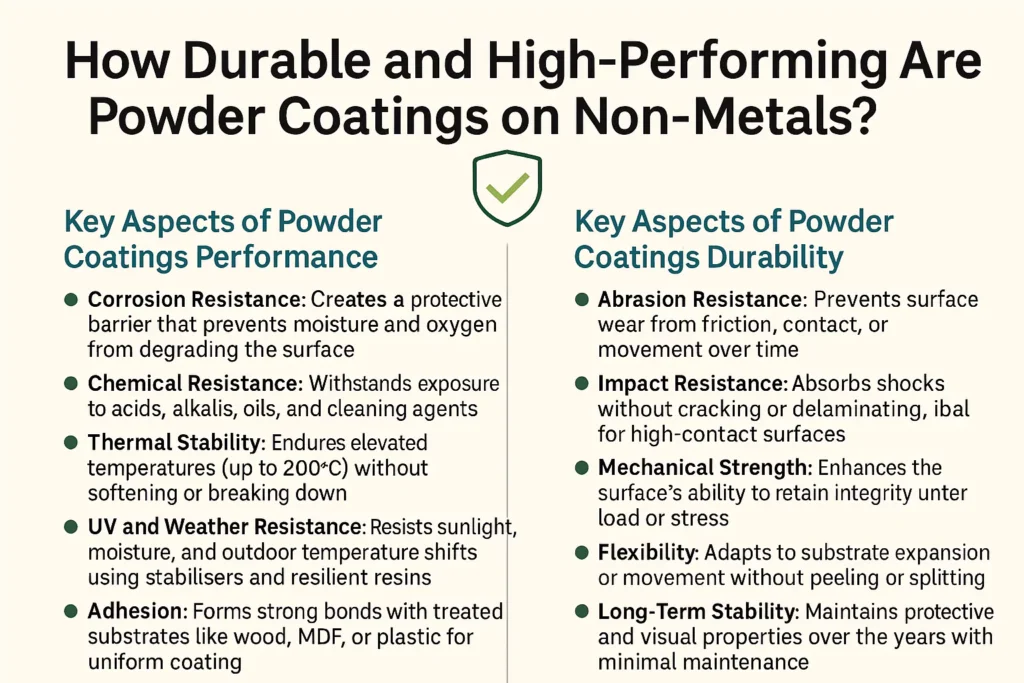
Performance and Durability of Powder Coatings on Non-Metals
Where Are Powder-Coated Non-Metal Materials Used in Industry?
Powder coating non-metal substrates has become increasingly common across industries that demand both aesthetic quality and high performance. Sectors like automotive, aerospace, consumer electronics, and furniture manufacturing have adopted this technique for its cost efficiency, environmental advantages, and functional durability.
Key Industry Applications and Use Cases:
- Automotive Interiors and Components
Powder coating is applied to non-metal parts such as dashboards, trim panels, and plastic covers. UV-cured powders provide uniform finishes with resistance to abrasion and temperature fluctuations. - Aerospace Components
Lightweight composite parts benefit from powder coatings due to their corrosion resistance and low-VOC application. Pre-treatment using steam and heat between 70°C and 140°C enables electrostatic coating even on non-conductive surfaces. - Consumer Goods and Electronics
Items like headphone casings, remote controls, and household appliances use powder-coated plastic for scratch resistance and visual appeal. Tribo charging helps coat complex plastic geometries evenly. - Furniture and Architectural Panels
MDF-based furniture, cabinetry, and wall panels are powder-coated for moisture resistance, surface durability, and aesthetic finish. UV-curable powders allow coating without damaging the substrate. - Medical and Laboratory Equipment
Devices require coatings with chemical resistance and easy-clean surfaces. Powder-coated composites and thermoplastics meet these hygiene standards.
These examples demonstrate how powder coating on non-metals solves industry-specific challenges by improving longevity, surface resilience, and design flexibility.