Table of Contents
- 1. What Makes Powder Coating Suitable for Architectural Applications?
- 2. Which Architectural Components Commonly Use Powder Coating?
- 3. What Performance Standards Must Architectural Powder Coatings Meet?
- 4. Which Industry Standards and Certifications Apply to Architectural Powder Coating?
- 5. How Does Powder Coating Compare to Anodising in Architecture?
- 6. How Should Powder-Coated Architectural Surfaces Be Installed and Maintained?
What Makes Powder Coating Suitable for Architectural Applications?
Powder coating is ideal for architectural applications because it combines mechanical strength, visual versatility, and ecological efficiency. It creates a dense, uniform coating that adheres electrostatically to surfaces, delivering long-term protection and consistent aesthetics.
Key Benefits of Powder Coating in Architecture
- Ensures long-term durability
- Forms a thick, uniform barrier against corrosion, UV radiation, and mechanical damage
- Withstands harsh climates, moisture, and pollutants without peeling or fading
- Suitable for external use on façades, steel structures, and exposed frames
- Delivers design versatility
- Offers thousands of RAL colours and custom hues
- Available in gloss, matte, satin, and textured finishes
- Ideal for replicating stone, wood, metallics, or heritage paint effects
- Supports sustainable construction
- Emits virtually no VOCs and contains no hazardous solvents
- Overspray can be recycled, reducing material waste
- Contributes to green building certifications like LEED and BREEAM
- Reduces lifecycle costs
- Requires minimal maintenance and cleaning
- Eliminates the need for frequent repainting
- Lowers total cost of ownership over 10–25 years of service
- Applies efficiently in manufacturing
- Fast curing times and efficient application processes
- Suitable for aluminium, galvanised steel, and mild steel substrates
- Ideal for high-volume architectural elements
Common Architectural Applications
- Façade cladding systems for commercial buildings
- Window and door frames are exposed to weathering
- Railings, fencing, and balustrades in public infrastructure
- Urban furniture and lighting poles require durable finishes
Which Architectural Components Commonly Use Powder Coating?
Powder coating is applied across a wide range of architectural components due to its durability, aesthetic flexibility, and resistance to environmental exposure. Metal elements in construction benefit from powder coating because it enhances both lifespan and appearance while reducing maintenance.
Powder-Coated Architectural Elements
- Window Frames and Door Systems
- Aluminium and steel frames are powder-coated to resist UV radiation, salt spray, and oxidation
- Enables colour matching across curtain walls and glazing systems
- Common in residential, commercial, and coastal properties
- External Doors and Door Frames
- Coated to resist wear, impact, and changing temperatures
- Available in woodgrain effects or solid RAL colours for design consistency
- Metal Roofs and Fascias
- Powder coating protects roofing sheets, fascias, and soffits from corrosion and fading
- Helps maintain structural integrity and colour vibrancy over time
- Suitable for sloped and standing seam metal roofs
- Balustrades, Railings, and Fencing
- High-traffic elements benefit from abrasion resistance
- Used in balconies, staircases, terraces, and public walkways
- Ensures long-term protection with minimal chipping or cracking
- Building Cladding and External Panels
- Powder-coated cladding improves weather resistance and design uniformity
- Often used in composite panels and architectural façades
- Gutters and Downpipes
- Coated to prevent rust, peeling, and moisture penetration
- Available in matte, gloss, or metallic finishes to match rooflines
- Outdoor Lighting Fixtures and Street Furniture
- Coating protects from UV, rain, and vandalism
- Common in parks, streetscapes, and commercial developments
What Performance Standards Must Architectural Powder Coatings Meet?
Architectural powder coatings must meet stringent performance standards to ensure long-term protection, aesthetic consistency, and structural reliability. These coatings are engineered to endure extreme weather conditions, UV radiation, and mechanical stress, making them suitable for external architectural components.
Core Performance Requirements
- Weather Resistance
- Coatings must withstand wind, rain, humidity, and temperature fluctuations without fading, chalking, or cracking
- Polyester-based powders are preferred for UV and moisture protection, especially in coastal or high-sun regions
- Substrate Compatibility
- Applied to aluminium, galvanised steel, and mild steel with pre-treatment for adhesion
- Supports long-term bonding and prevents underfilm corrosion
- Aesthetic Consistency
- Coatings must retain colour and gloss levels over decades
- Must offer texture uniformity across profiles, panels, and architectural systems
- Compliance with Standards
- Must meet specifications such as AAMA 2603, 2604, and 2605 for performance, gloss retention, and weatherability
- Class 2 powders offer higher durability for premium projects
- Mechanical Durability
- Must resist abrasion, impact, and chemical exposure
- Critical for high-touch areas like railings and access doors
Powder coatings meeting these standards help preserve the visual and structural integrity of architectural projects, even under the harshest environmental pressures.

Which Industry Standards and Certifications Apply to Architectural Powder Coating?
Architectural powder coatings must comply with established international and regional standards to guarantee performance, consistency, and durability. These certifications assess factors such as coating thickness, colour retention, weather resistance, and pre-treatment quality, ensuring reliable results across various environmental conditions.
Key Industry Standards
- BS EN 12206 (UK)
- Governs the application of organic coatings on aluminium for architectural use
- Specifies minimum film thickness, adhesion, gloss levels, and resistance to corrosion
- Requires surface preparation such as chromate-free pre-treatment for enhanced adhesion
- AAMA 2603 / 2604 / 2605 (USA)
- Defines three levels of performance:
- 2603: Basic durability for interior and low-exposure exterior use
- 2604: Superior UV resistance, colour retention, and weathering for commercial applications
- 2605: Highest level, intended for high-rise and coastal environments with 10+ year durability
- Defines three levels of performance:
- Qualicoat (Global)
- International quality label for powder coatings on aluminium
- Assess powder type, substrate preparation, application process, and performance testing
- Certifies compliance with accelerated weathering, gloss retention, and adhesion
- GSB International
- Sets quality standards for industrial coating systems across Europe
- Focuses on environmental safety, consistent colour output, and cross-bond adhesion
Importance for Architects and Specifiers
Compliance with these standards ensures long-term protection and visual integrity of façades, curtain walls, windows, and other exterior components. Certified applicators and products help meet building code requirements and support project warranties.
How Does Powder Coating Compare to Anodising in Architecture?
In architectural applications, powder coating and anodising are both used to enhance aluminium’s lifespan and appearance. However, they differ in application method, performance characteristics, and design flexibility. The table below compares their core attributes:
Feature | Powder Coating | Anodising |
Colour and Finish Options | Wide variety of colours, textures, gloss levels (RAL, custom shades) | Limited to natural metallic tones (silver, bronze, black) |
Surface Protection | Forms a thick external barrier against corrosion, UV, and chemicals | Creates an integral oxide layer for high corrosion resistance |
Scratch Resistance | Moderate scratch resistance, depending on powder type | High surface hardness; excellent scratch resistance |
Durability in Harsh Environments | Suitable with proper pre-treatment; good resistance to fading and chalking | Excellent resistance in industrial or coastal zones |
Maintenance Requirements | Low maintenance; colour stable over time | May show fingerprints and watermarks more easily |
Repairability | Damaged areas can be touched up or recoated | Difficult to repair seamlessly |
Sustainability | Low-VOC, recyclable overspray, energy-efficient process | Requires chemical baths; harder to recycle anodised parts |
Standards Compliance | BS EN 12206, Qualicoat, AAMA 2603/2604/2605 | BS 3987, ISO 7599, Qualanod |
Both methods offer durability, but powder coating provides more aesthetic freedom and easier maintenance, while anodising delivers superior surface hardness and corrosion resistance.
How Should Powder-Coated Architectural Surfaces Be Installed and Maintained?
Proper installation and routine maintenance are essential for preserving the performance, appearance, and lifespan of powder-coated architectural elements. Coated surfaces require correct handling during installation and sensitive cleaning methods to avoid surface damage or premature degradation.
Installation Guidelines
- Handle with care: Avoid dragging or stacking coated items to prevent scratches. Use padded supports during transport.
- Protect surfaces on-site: Cover powder-coated areas during construction to shield from dust, mortar, and welding debris.
- Seal joints and edges: Use compatible sealants that do not chemically react with the coating.
- Inspect for damage: Check coatings for chips or abrasions after installation; repair promptly using manufacturer-approved touch-up systems.
Maintenance Best Practices
- Clean regularly: Use mild soap and lukewarm water with a soft cloth or sponge. Rinse thoroughly to prevent residue build-up.
- Avoid abrasives: Do not use scouring pads, solvents, or acidic cleaners. These can dull or degrade the finish.
- Limit over-cleaning: Clean only when contaminants are visible; excessive washing can cause surface erosion.
- Enhance protection: Apply non-abrasive automotive wax to high-contact areas (e.g. doors, handrails) for added protection against pollutants and wear.
- Monitor exposure zones: Increase cleaning frequency in coastal or industrial environments to prevent salt or chemical accumulation.
Correct maintenance extends coating performance beyond 15–20 years, ensuring both structural integrity and visual quality.
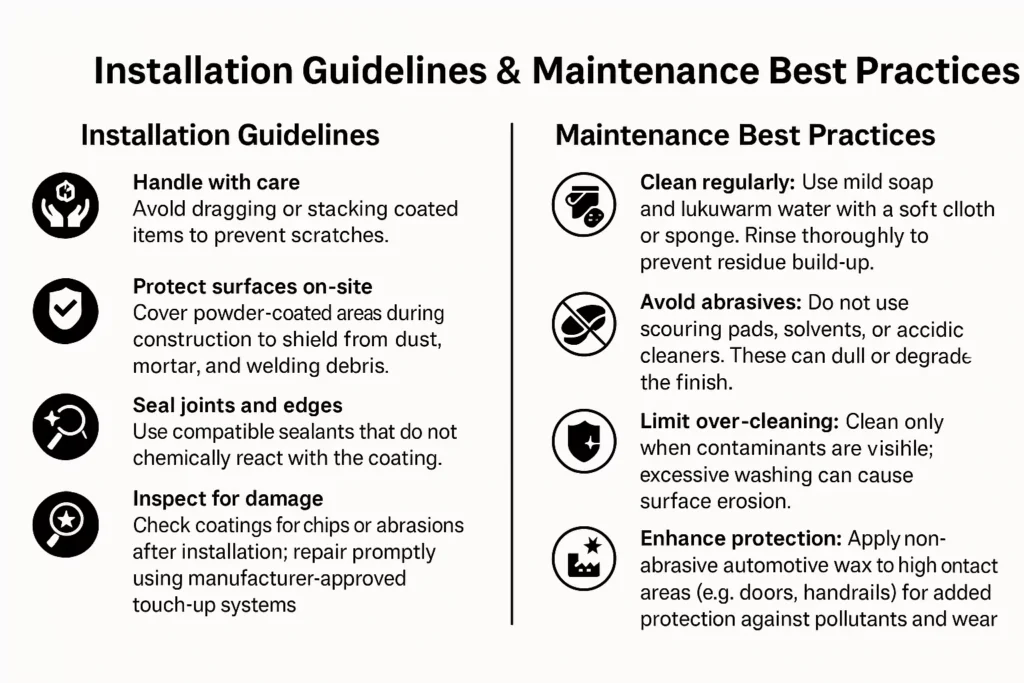
Installing and Maintaining Powder-Coated Architectural Surfaces