Table of Contents
What Is a Powder Coating Booth?
A powder coating booth is a controlled application environment designed to contain overspray, protect operators, and ensure a consistent finish. It encloses the spraying area, preventing powder drift and promoting clean, efficient application.
The booth integrates an airflow system and cartridge or cyclone filtration to capture airborne powder and maintain visibility. By isolating the coating process, it reduces contamination risk and supports NFPA 33 compliance for fire safety.
There are two primary types:
- Batch booths: Ideal for small-batch or manual coating, where parts are stationary.
- Conveyor line booths: Suited for automated or high-throughput production; parts move through on a conveyor, enabling continuous spraying.
Each booth type varies in footprint, application method, and overspray recovery capacity. Booth choice depends on part size, coating volume, available space, and investment level.
A well-designed booth safeguards workers, improves powder efficiency, and ensures high-quality coating adhesion and finish uniformity.
Key Components of a Powder Coating Booth
A powder coating booth operates as a controlled environment that ensures safe application, powder containment, and finish consistency. Every component serves a defined role in maintaining efficient airflow, proper particle management, operator visibility, and NFPA 33 compliance.
1. Enclosure Walls and Doors
Booth walls are made of galvanised steel, aluminium, or flame-retardant plastic curtains. Single-skin panels offer rigidity and cost-efficiency, while dual-skin walls provide insulation and light reflectivity. Doors, whether roll-up, solid, or filtered, regulate pressure and control contamination between zones.
2. Exhaust System and Airflow Control
Airflow systems must maintain proper CFM (cubic feet per minute) for booth size. Downdraft or cross-draft configurations determine air movement. Exhaust plenums, typically at the rear or floor, are paired with ducting to vent air externally.
3. Cartridge Filters or Cyclone Separators
Cartridge filters trap fine powder efficiently and are ideal for enclosed booths. Cyclone separators are better suited for high-volume, reclaim-focused operations. Filter loading is monitored via manometers or draft gauges.
4. Lighting and Visibility
Shadow-free, high-lumen LED lighting allows operators to visually track powder deposition. White booth interiors increase reflectivity, improving visibility and reducing coating errors.
5. Grounded Floor and Grating
A grounded metal grating enables proper electrostatic grounding of parts and racks, ensuring uniform powder attraction and reducing fire hazards.
6. Optional Powder Reclaim System
Reclaim systems collect overspray for reuse, improving material efficiency. Integrated recovery hoppers and auto-feed systems are common in automated or high-volume booths.
What type of powder coating booth is best for your workflow?
Selecting the right powder coating booth type depends on your workflow, part size, throughput needs, and workspace layout. Booth design affects powder containment, operator access, and overall efficiency, whether you’re setting up a compact DIY station or a full-scale industrial line.
1. Open-Face vs Enclosed Booths
- Open-face booths offer high visibility and easy part access. They’re ideal for low-volume work or when space is limited.
- Enclosed booths provide controlled airflow and better powder containment, crucial for high-precision finishes and overspray management.
2. Bench-Top, Walk-In, or Pass-Through Booths
- Bench-top booths suit small parts or lab-scale work; compact, portable, and easy to clean.
- Walk-in booths allow access for operators and large parts, offering flexibility for varied workloads.
- Pass-through booths streamline production lines, enabling parts to move through for continuous coating.
3. Sizing Based on Part Dimensions and Throughput
- Match booth internal dimensions to the largest part you’ll coat.
- Maintain clearance around all sides to support airflow and operator movement.
- Standard booth sizes range from 1m² (bench) to 3×3×2.5m (walk-in) for industrial applications.
4. Prefab, DIY, or Modular Kits
- Prefab booths are factory-built, tested for compliance (e.g., NFPA 33), and fast to install.
- DIY setups cost less but require expertise in airflow system design and safety compliance.
Modular booths offer scalability and reusability, ideal for growing workshops or changing product lines.

Best Powder Coating Booth for Workflow
How to Set Up a Powder Coating Booth?
Setting up a powder coating booth involves precise planning to ensure safety, coating quality, and regulatory compliance. Each element location, airflow, grounding, and lighting directly affects performance and finish results.
1. Site Selection & Ventilation
- Choose an isolated area: Install the booth away from curing ovens and airflow disruptions.
- Ensure proper airflow design:
- Cross-draft: Horizontal airflow, suitable for basic setups.
- Downdraft: Vertical airflow, better for overspray control and finish quality.
- Confirm airflow capacity: Use a fan system that supports the required CFM (Cubic Feet per Minute) to extract overspray and airborne particles effectively.
2. Electrical & Grounding Setup
- Ground all components: Install grounded floor grids and ensure racks are conductive to prevent static buildup.
- Install static control systems: Use anti-static mats or conductive floor coatings.
- Electrical safety: Follow local codes and use properly insulated wiring and E-stop systems for operator safety.
3. Filter & Airflow Calibration
- Use compatible filters: Choose cartridge filters or cyclone separators based on booth size and usage.
- Monitor performance: Install a manometer to track pressure drop and replace filters per manufacturer specs.
- Balance airflow: Test for uniform airflow across the booth to reduce overspray drift.
4. Lighting & Accessibility
- Install bright, shadow-free lighting: Use LED strip lighting rated for industrial environments.
Maintain operator accessibility: Ensure wide, open access points for easy gun movement and part handling.
What Safety Standards Apply to Powder Coating Booths?
Powder coating booths must follow strict safety standards to reduce the risk of fire, explosion, and worker exposure. Regulations like NFPA 33 and OSHA set specific requirements for ventilation, combustible dust control, personal protective equipment (PPE), and automated safety features in spray and curing systems.
NFPA 33 & OSHA Ventilation Requirements
Adequate airflow is critical to keeping airborne powder concentrations below the lower explosion limit (LEL). NFPA 33 and OSHA require that spray booths include high-efficiency ventilation systems with steel ducting, sealed joints, and explosion-proof fans and motors. Poor airflow increases the risk of ignition from electrical or mechanical sources.
Fire Risk from Powder Accumulation
Overspray and dust buildup present significant fire hazards. Spray booths must be designed and operated to prevent powder concentrations from exceeding 50% of the LEL. Proper application techniques, reduced spray rates, and regular cleaning routines help control overspray. Ignition sources such as static, open flames, or hot surfaces must be eliminated.
PPE for Operators
Operators must wear appropriate PPE to prevent inhalation and skin contact with powder particles. This includes respiratory protective equipment with an Assumed Protection Factor (APF) of 20 or higher, anti-static gloves, safety goggles, and protective clothing. PPE reduces the risk of respiratory irritation and exposure to fine particulates.
Interlocking with Gun or Oven Systems
Spray guns and curing ovens should have built-in interlock systems. These include high-temperature limit controls, auto shut-off valves, and non-resetting thermostats to prevent overheating or unintentional operation. Safety timers also control drying cycles and fuel shut-off in case of malfunction.
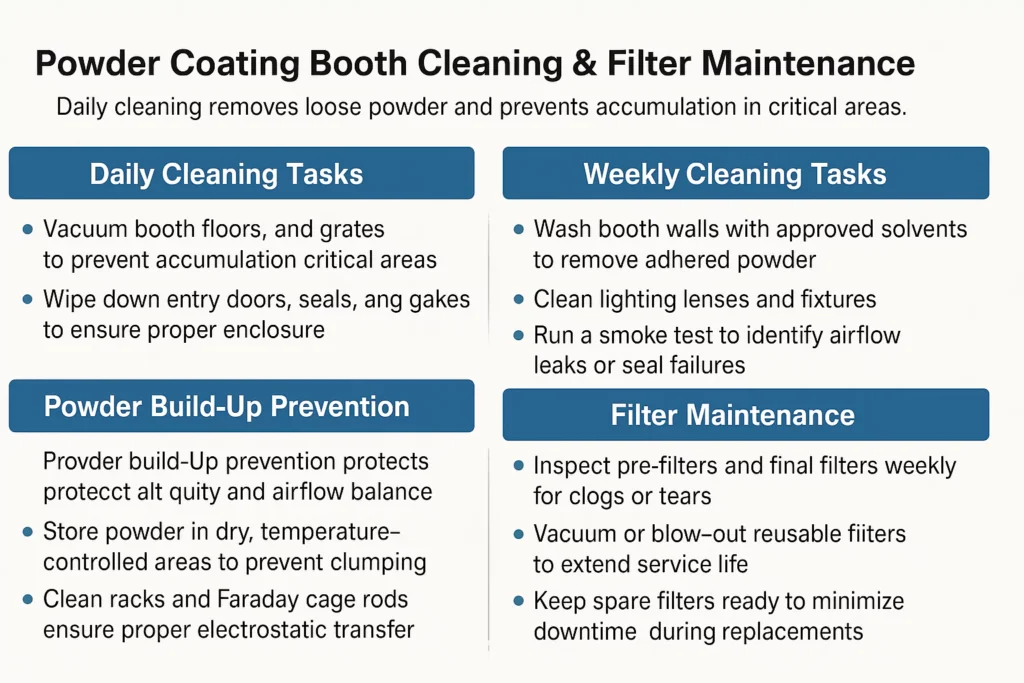
How Do You Maintain and Clean a Powder Coating Booth?
Proper maintenance of a powder coating booth ensures consistent finish quality, extends equipment lifespan, and prevents airflow blockages. Cleaning schedules should follow a strict routine based on powder load, booth size, and filter type.
Daily Cleaning Tasks
Daily cleaning removes loose powder and prevents accumulation in critical areas.
- Vacuum booth floors and grates to prevent powder compaction.
- Wipe down entry doors, seals, and gaskets to ensure proper enclosure.
- Check cartridge filters for visible powder loading or pressure changes.
Weekly Cleaning Tasks
Weekly cleaning targets hardened build-up and system inefficiencies.
- Wash booth walls with approved solvents to remove adhered powder.
- Clean lighting lenses and fixtures to restore visibility.
- Run a smoke test to identify airflow leaks or seal failures.
Powder Build-Up Prevention
Preventing powder accumulation protects part quality and airflow balance.
- Store powder in dry, temperature-controlled areas to prevent clumping.
- Clean racks and Faraday cage rods to ensure proper electrostatic transfer.
- Ensure proper airflow (CFM levels) using calibrated exhaust systems.
Filter Maintenance
Filter maintenance is critical for airflow control and operator safety.
- Inspect pre-filters and final filters weekly for clogs or tears.
- Vacuum or blow out reusable filters to extend service life.
- Keep spare filters ready to minimise downtime during replacements.
Powder Coating Booth Maintain and Cleaning Process