Table of Contents
What Is a Curing Oven in Powder Coating?
A curing oven in powder coating is a high-temperature industrial furnace that solidifies powder into a durable, adhesive coating. It activates after powder is applied electrostatically to a part’s surface. Curing begins once the object enters the oven, where heat initiates a chemical process: the powder melts, flows, gels, and cross-links into a tough, continuous film.
This transformation requires controlled temperatures, typically 160°C to 200°C, held for a defined time to trigger full polymerisation. Curing ovens ensure the correct bond strength, finish quality, and corrosion resistance of the final coated product.
These ovens use either convection heating (via circulated hot air) or infrared radiation to maintain uniform thermal distribution. Accurate thermocouple readings and airflow balance are crucial for avoiding under- or over-curing, especially for complex geometries.
Curing ovens play a key role in the automotive, aerospace, and metal fabrication sectors, supporting repeatable, high-efficiency surface finishing workflows.
How Powder Curing Works?
Powder curing is the transformation phase where the applied powder turns into a tough, chemically bonded film. Once a part is coated, it enters a curing oven, where controlled heat causes the powder to undergo a multi-stage process: melting, flowing, gelling, and finally, cross-linking. These steps lock the coating into a solid, high-performance finish.
The curing begins as oven temperatures reach between 160°C and 200°C, depending on the powder chemistry and substrate. The heat causes the powder particles to melt and flow, evening out across the surface. Thermoset powders undergo a chemical reaction known as cross-linking, creating strong molecular bonds. This forms a dense network that resists scratches, chemicals, and UV degradation. Thermoplastic powders, in contrast, only melt and re-solidify without chemical bonding.
Key curing variables include:
- Substrate mass and geometry
- Powder type (epoxy, polyester, hybrid, UV-cure)
- Required film properties
Curing time can range from 8 to 25 minutes, depending on part thickness and powder formulation. Over-curing can lead to discolouration, while under-curing reduces adhesion and durability. Monitoring oven profiles and using ramp-up control ensures consistency.
Types of Powder Coating Curing Ovens
Powder coating curing ovens are classified by their heating method, primarily convection, infrared (IR), or a hybrid of both. Each type affects curing time, heat transfer efficiency, and suitability for specific parts or production volumes.
Convection Ovens
Convection ovens use heated air, circulated by fans, to raise the substrate temperature. This heat penetrates from the outside inward, making them ideal for large, metal parts with complex shapes.
- Available in electric or gas-fired versions
- Slower cure cycle, usually 10–25 minutes
- Suited for batch operations and low to mid-volume production
- Better for heat-sensitive materials due to even temperature distribution
Infrared (IR) Ovens
Infrared ovens use radiant energy to directly heat the part surface. The heat transfer is faster and more localised, often reducing cycle times by 30–50%.
- Best for flat or thin parts
- Ideal for high-speed lines or continuous production
- Limited penetration on large or dense objects
- Generally higher upfront cost
Hybrid Ovens
Hybrid curing ovens combine convection and infrared technologies for enhanced flexibility.
- Preheating via IR, followed by convection hold time
- Useful for mixed part geometries
- Efficient energy use with balanced heat profiles
When selecting a curing oven, consider part geometry, throughput demands, and energy efficiency. Safety standards also matter: Class A ovens are required for volatile compounds; Class B ovens are typical for standard powder applications.

Powder Coating Curing Ovens
Powder Curing Temperature and Time Chart
Powder coating cures through a precise combination of heat and time, which enables the coating to melt, flow, and chemically bond into a hardened film. These parameters vary by powder formulation, part size, and substrate material. Cure schedules are typically based on the metal temperature, not just the ambient oven temperature.
Standard vs Low-Temperature Powders
Most standard thermoset powders require a metal temperature of 180–200°C sustained for 10–20 minutes. This ensures complete cross-linking and optimal film performance.
Low-cure powders, developed for energy savings or heat-sensitive substrates like MDF, cure at 120–140°C but require longer dwell times, typically 20–25 minutes.
Cure Time Variability Factors:
- Part thickness delays core heat-up
- Oven type and airflow influence heat distribution
- Powder chemistry dictates the minimum cure energy
- Ramp-up rates affect total oven dwell time
Example Curing Schedules:
Powder Type | Cure Temp (°C) | Cure Time (min) |
Epoxy | 180–200 | 10–12 |
Polyester | 160–190 | 15–20 |
Hybrid | 180–190 | 10–15 |
Low-Temp | 120–140 | 20–25 |
Excessive curing can degrade gloss or cause discolouration. Undercuring weakens adhesion and resistance. Use thermocouples to track real-time part temperatures and cure curves to validate optimal conditions for each application.
Choosing the Right Curing Oven
Selecting the right curing oven for powder coating depends on matching your production requirements with the oven’s technical capabilities. Core considerations include part size, throughput, available space, budget, and the specific powder chemistry used.
Key Selection Factors
- Production Volume: For small batches, a box oven offers flexibility and lower upfront cost. For high-volume runs, a tunnel oven with a conveyor system allows continuous processing.
- Part Dimensions: The oven must fit your largest part with clearance for airflow. Oversized parts require custom or walk-in ovens.
- Heating Type:
- Convection ovens (electric or gas) are versatile and suitable for mixed part geometries.
- Infrared ovens deliver faster cycle times but work best with flat, thin components.
- Hybrid ovens combine both for balanced performance and energy efficiency.
- Curing Requirements: Ensure the oven can maintain the metal temperature needed for your powder’s cure schedule, typically 160–200°C.
- Temperature Recovery: A good oven returns to set temperature quickly after each load, ensuring consistent film quality.
- Airflow and Ducting: Uniform airflow prevents undercured spots and supports even heating across complex shapes.
- Control Features: Digital or programmable PID controllers help manage repeatable curing cycles for different coatings.
- Safety Compliance: Choose Class A ovens when flammable vapours or solvents are present. For standard powder applications, Class B is typically sufficient.
Maintenance and Calibration
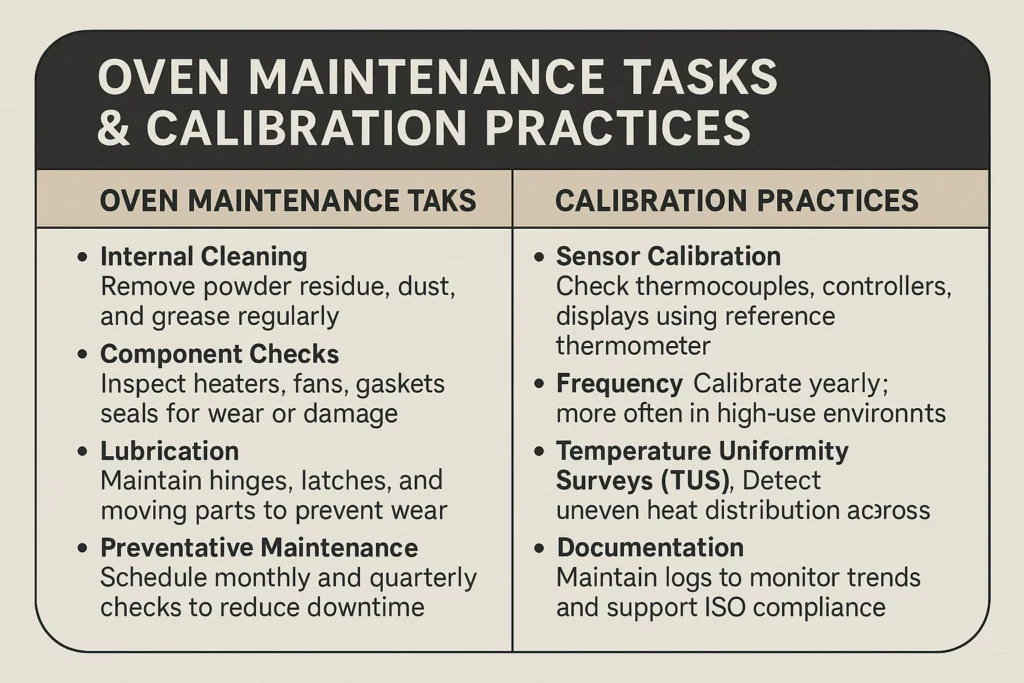
Routine maintenance and accurate calibration are essential to keep powder coating curing ovens operating within specified tolerances. Inconsistent temperatures can cause undercuring or overcuring, which directly affects coating adhesion, hardness, and visual quality.
Oven Maintenance Tasks
- Internal Cleaning: Remove powder residue, dust, and grease regularly to prevent contamination and thermal interference.
- Component Checks: Inspect heating elements, fans, gaskets, and door seals for wear or damage. Faulty parts can disrupt airflow and heat distribution.
- Lubrication: Keep hinges, latches, and mechanical moving parts lubricated to avoid premature wear and binding.
- Preventative Maintenance Plans: Implement a scheduled checklist for monthly and quarterly inspections. This helps extend oven lifespan and avoid unscheduled downtime.
- Environment Monitoring: Operate the oven in conditions that meet the manufacturer’s environmental specs for ambient temperature and humidity.
Calibration Practices
- Sensor Calibration: Verify and calibrate thermocouples, controllers, and digital displays using a reference-grade thermometer.
- Frequency: Perform full calibration annually, or more often in high-volume environments.
- Temperature Uniformity Surveys (TUS): Conduct TUS testing to identify hot spots or cold zones, ensuring even curing across all rack positions.
- Documentation: Keep detailed calibration logs to track accuracy trends and prove compliance with ISO or quality standards.
Maintenance and Calibration for Powder Coating Curing Ovens
Energy Efficiency and Safety Standards
Powder coating curing ovens must meet strict energy efficiency and safety standards to ensure reliable performance, cost-effectiveness, and compliance with regulations. High energy consumption and safety risks can increase operating costs and affect production continuity.
Improving Energy Efficiency
- Insulation Quality: Thick, high-density insulation minimises heat loss. A standard of 4 lbs/ft³ or more helps retain internal temperatures and lowers fuel usage.
- Door Seals and Construction: Heavy-duty gaskets and 16-gauge steel construction improve thermal containment and oven longevity.
- Programmable Controls: PID controllers enable precise temperature management and automate cure cycles, reducing unnecessary heat exposure.
- Heat Recovery Systems: Recuperation or waste heat recovery units recycle expelled heat back into the process, improving efficiency by up to 15–30%.
- Airflow Management: Balanced ductwork and airflow dampers ensure even heating, preventing hot or cold spots.
Meeting Safety Standards
- Emergency Shut-Off Systems: Essential for halting operation instantly in the event of overheating or fire.
- Temperature Interlocks: These prevent the oven from operating outside its designed range, protecting parts and equipment.
- Over-Temperature Alarms: Early warnings help prevent critical failures due to temperature spikes or control faults.
- Ventilation and Extraction: Proper ventilation removes fumes or vapours during curing, essential for worker safety and air quality.
- Compliance and Certification: Ensure your oven meets UKCA, CE, NFPA, or OSHA standards, depending on your region and sector.