Table of Contents
- 1. What Is Coating Thickness in Powder Coating?
- 2. What Is the Recommended Thickness Range for Powder Coating?
- 3. Which Industry Standards Define Powder Coating Thickness Requirements?
- 4. How Can You Accurately Measure Powder Coating Thickness?
- 5. How Does Coating Thickness Affect Performance and Durability?
- 6. What Are the Most Common Defects Caused by Incorrect Coating Thickness?
What Is Coating Thickness in Powder Coating?
Coating thickness in powder coating refers to the dry film layer applied over a substrate, usually measured in mils (1 mil = 25.4 microns) or microns. It defines the film build, impacting durability, adhesion, and aesthetic finish.
The standard thickness for most powder coatings ranges between 2.0 to 5.0 mils (50–125 microns). This thickness achieves a balance between mechanical protection and visual uniformity. The applied thickness depends on the application method (e.g., electrostatic spray or fluid bed), coating type, and the applicator’s technique.
Different use cases demand different builds:
- Thin films (as low as 1 mil) support easy stripping or temporary finishes.
- Thicker coatings (>5 mils) offer higher abrasion resistance and chemical protection, especially for heavy-duty industrial uses.
Thickness measurement occurs post-curing, using instruments like magnetic pull-off gauges or ultrasonic film thickness meters. These ensure that the applied layer meets specifications without exceeding limits that cause orange peel or sagging.
Incorrect thickness alters corrosion resistance, texture, and colour uniformity. Over-application can trap air or solvents, while under-application risks chipping and poor edge coverage.
What Is the Recommended Thickness Range for Powder Coating?
The recommended powder coating thickness typically falls between 2–3 mils (50–75 microns) for general-purpose applications. This range ensures a balance between protection, flexibility, and aesthetic quality across most substrates.
The ideal film thickness depends on multiple variables:
- Application type: Thin films (e.g., 30–50 microns) suit intricate shapes or decorative finishes. Thicker coatings (2.5–3.5 mils) are ideal for high-impact, corrosion-prone, or exterior components.
- Substrate surface: Rough or abrasive surfaces like blasted steel often require thicker coatings to achieve uniform coverage and barrier protection.
- Performance demands: Coatings subject to UV, abrasion, or chemical exposure need greater film build to maintain structural integrity and long-term function.
- Curing dynamics: The curing temperature and dwell time directly influence final film thickness and mechanical properties.
Thickness is measured post-cure using electronic dry film thickness (DFT) gauges, calibrated for the substrate material. Units may be expressed in mils (imperial) or microns (metric), depending on the industry standard.
For precision, manufacturers’ technical data sheets should always be referenced to determine the product-specific recommended DFT range.
Which Industry Standards Define Powder Coating Thickness Requirements?
Powder coating thickness is regulated by industry standards to ensure performance, durability, and compliance. These standards define the acceptable dry film thickness (DFT) and testing procedures across different substrates and conditions.
Key Industry Standards
Standard | Purpose |
ISO 2808 | Defines methods for measuring wet and dry film thickness |
ASTM D7091 | Covers magnetic and eddy current DFT measurement methods |
SSPC-PA 2 | Specifies DFT tolerances for coatings on steel structures |
Qualicoat | Architectural powder coatings: 60–80 microns (2.4–3.2 mils) recommended |
AAMA 2605 | Applies to high-performance architectural finishes |
ISO 12944 | Corrosion protection for steel via paint and powder coating |
Performance and Application Guidelines
- Corrosion resistance often requires DFT ≥ 75 microns, depending on ISO 12944 classification.
- Hot-dip galvanised steel coatings typically average 85 microns (7mm steel).
- Decorative or indoor coatings may suffice at 50 microns, but outdoor and marine coatings demand higher builds.
- Surface roughness (Ra), often 0.8–3.2 microns, affects coating adherence.
Measurement Techniques
- Coating Thickness Gauges: Use eddy current or magnetic induction methods for non-destructive DFT checks.
- Wet Film Gauges: Apply during coating to adjust WFT before curing; used with knowledge of volume solids to predict final DFT.
Accurate measurement and adherence to standards prevent failure, ensure compliance, and optimise both cost and performance.

Thickness Requirements for Powder Coated Finishes
How Can You Accurately Measure Powder Coating Thickness?
Measuring coating thickness is essential for quality assurance and performance validation. Methods are grouped into non-destructive and destructive techniques. The choice depends on coating type, substrate, accuracy needed, and whether the part can be damaged.
Non-Destructive Methods
- Magnetic Induction Gauges: Measure non-magnetic coatings (e.g., paint) on magnetic metals (steel, iron). Suitable for ferromagnetic substrates. High accuracy, widely used.
- Eddy Current Gauges: Detect non-conductive coatings on conductive, non-magnetic substrates like aluminium. Ideal for anodised films, plastics, and powder coatings on aluminium.
- Ultrasonic Thickness Gauges: Use ultrasonic pulse reflection to determine coating thickness from one side only. Effective for multi-layer coatings and inaccessible areas.
- X-ray Fluorescence (XRF): Measures elemental composition and coating thickness using X-rays. Non-contact, suitable for thin coatings and alloy layers. Expensive and used in specialised industries.
- Beta Backscattering: Emits beta particles to estimate coating thickness. Limited use due to cost and safety concerns.
Destructive Methods
- Optical Microscopy: Involves cross-sectioning and microscopic analysis. Offers precise thickness data but destroys the sample.
- Coulometry: Electrically dissolves the coating to measure layer thickness. Used for very thin or electroplated coatings.
- SEM and AES: High-resolution imaging and compositional analysis; ideal for research and lab settings.
Summary Table
Method | Type | Best For | Limitations |
Magnetic Induction | Non-destructive | Steel substrates | Not for non-magnetic materials |
Eddy Current | Non-destructive | Aluminium, copper | Less precise on thick layers |
Ultrasonic | Non-destructive | Multilayer, thick coatings | Calibration needed |
XRF | Non-destructive | Thin, layered, metallic coatings | High cost, specialised use |
Optical Microscopy | Destructive | Cross-section analysis | Damages the part |
How Does Coating Thickness Affect Performance and Durability?
Coating thickness directly affects durability, functionality, and aesthetic quality. While thicker layers can offer stronger protection, improper build-up may lead to performance failures.
Positive Impacts of Increased Thickness
- Corrosion resistance improves as thicker coatings provide stronger barriers against moisture, chemicals, and oxygen.
- Wear resistance increases, especially with hard powder coatings used in high-friction environments.
- Thermal insulation is enhanced in thick thermal barrier coatings, reducing heat transfer in engines and machinery.
- Adhesion may be better on rough substrates when thicker coatings are used.
Negative Impacts of Excessive Thickness
- Cracking and delamination occur if the coating becomes too rigid or fails to cure properly.
- Cost increases result from higher material usage and rework due to surface defects.
- Reduced flexibility in thick coatings can lead to poor impact resistance or stress fractures.
- Electrical resistance may rise in conductive applications, reducing system efficiency.
Key Factors for Optimal Thickness
Factor | Influence |
Application type | Defines mechanical, thermal, or chemical needs |
Coating material | Determines ideal thickness range |
Environment | Harsh conditions require thicker builds |
Standards (ISO, ASTM) | Ensure specification compliance |
What Are the Most Common Defects Caused by Incorrect Coating Thickness?
Incorrect coating thickness, either too much or too little, can cause functional and aesthetic issues. These defects compromise durability, adhesion, and surface appearance, often leading to premature failure or costly rework.
Defects from Excessive Thickness
- Cracking: Caused by internal stresses in thick coatings, particularly on rigid or thermally active substrates.
- Delamination: Occurs when overly thick coatings detach due to poor curing or low surface roughness.
- Blistering: Forms when solvents or moisture are trapped beneath thick films, especially under high humidity.
- Sagging and Running: Results from heavy application on vertical or uneven surfaces.
- Orange Peel: Uneven atomisation or improper spray technique leads to a textured, dimpled surface.
- Mud Cracking: Resembles dry soil; appears in brittle, inflexible, overly thick coatings.
- Wrinkling: Happens when surface skin forms over a wet interior due to solvent entrapment or rapid drying.
Defects from Insufficient Thickness
- Pinpoint Rusting: Arises when thin coatings expose metal to corrosive environments.
- Visible Substrate: Aesthetically unacceptable, particularly with translucent or low-opacity coatings.
- Increased Cure Time: Thin films may not cure as expected, impacting durability.
- Poor Barrier Performance: Reduced film thickness weakens resistance to chemicals, UV, and moisture.
Additional Causes and Contributing Factors
- Poor Surface Preparation: Oil, dust, or smooth finishes reduce adhesion.
- Incorrect Application: Spray gun angle, speed, and distance affect layer uniformity.
- Environmental Conditions: High humidity or temperature variations during curing lead to defects like blushing, cratering, and checking.
- Contamination: Silicone, moisture, or incompatible materials cause issues like fish eyes, pinholing, and peeling.
Proper training, substrate prep, and application control are essential to minimise these defects.
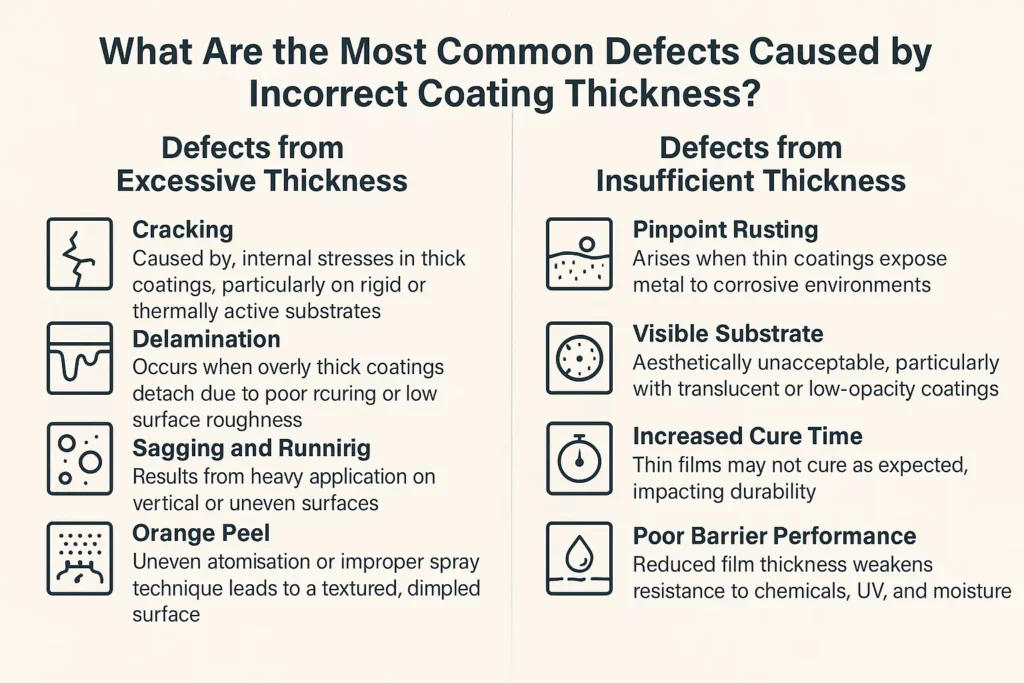
Usual Flaws Due to Incorrect Powder Coating Thickness