Powder coating offers a durable, VOC-free finish that is widely used across industries from automotive to architecture. However, this process presents serious health, fire, and environmental risks if not managed correctly. This guide outlines the essential safety measures, protective equipment, ventilation practices, and legal standards required to maintain a safe and compliant powder coating environment under UK regulations.
Table of Contents
- 1. What Hazards Are Involved in Powder Coating?
- 2. What PPE is Required in Powder Coating Operations?
- 3. What Engineering Controls Are Required?
- 4. How Do You Prevent Fires and Explosions?
- 5. How Should Powders Be Handled and Stored?
- 6. What Safety Regulations Apply in the UK?
- 7. What Are the Best Practices for Training and Safety Monitoring?
What Hazards Are Involved in Powder Coating?
Powder coating processes generate fine particles, use electrostatic equipment, and involve curing at high temperatures, all of which introduce workplace hazards.
Combustible Dust
Fine powder particles suspended in the air can ignite if they come into contact with a spark, flame, or heat source. In confined spaces, this may lead to an explosion. Under the Dangerous Substances and Explosive Atmospheres Regulations 2002 (DSEAR), most thermoset powders are classified as potentially explosive dusts.
Inhalation Risks
If powder becomes airborne, it can be inhaled by operators. Prolonged exposure may lead to respiratory issues such as irritation, sensitisation, or occupational asthma. Without adequate control measures and respiratory protection, these risks increase.
Electrical Hazards
Electrostatic spray guns operate at high voltages (up to 100kV). Improper grounding or damaged cables can result in electric shock or discharge, which may ignite powder particles in the surrounding air.
Fire Risk During Spraying and Curing
Powder accumulation around ovens, filters, or booth corners may ignite when exposed to heat or electrical faults. Fires often start where overspray settles and goes unnoticed for extended periods.
What PPE is Required in Powder Coating Operations?
Personal protective equipment is critical in reducing operator exposure to powders, static electricity, and mechanical hazards. Under the Personal Protective Equipment at Work Regulations 2022, all PPE must be suitable, maintained, and provided free of charge.
Essential Equipment Includes:
- Respiratory protection: Half-mask respirators with P3 filters are suitable for most powder applications.
- Coveralls: Antistatic, full-body suits prevent powder adhesion to clothing and reduce static build-up.
- Gloves: Powder-free, antistatic gloves protect the hands and prevent electric shocks.
- Goggles or visors: Safety goggles should meet BS EN 166 standards to protect against powder ingress.
- Hearing protection: Ear defenders are needed if working near curing ovens or air compressors.
All PPE must be inspected regularly, stored properly, and replaced as necessary. Operators should be trained in how and when to wear each item.
What Engineering Controls Are Required?
Engineering controls are the systems and equipment that manage risks at their source. These should be installed and maintained to control dust levels, manage air quality, and reduce the build-up of flammable particles.
Ventilation and Airflow
Spray booths should be fitted with adequate extraction systems that maintain a cross-draft or downdraft airflow of at least 0.5 m/s (metres per second). Local exhaust ventilation (LEV) systems must be tested every 14 months under COSHH Regulation 9.
Dust Filtration
Install cartridge filters or cyclone separators to remove powder from the air. Filters must be rated for fine particulate capture and checked weekly. Blocked filters reduce booth efficiency and increase the risk of dust accumulation.
Grounding and Static Control
All conductive parts, including the spray gun, racks, hooks, and operator footwear, must be earthed. Bonding resistance should be kept below 1 megaohm, and continuity should be tested regularly. Antistatic flooring and shoes should also be used in high-risk areas.

Engineering Controls Are Required for Powder Coating
How Do You Prevent Fires and Explosions?
Powder coating environments are prone to fire and explosion risks due to the presence of fine dust, high voltage systems, and heat from curing ovens. Effective prevention relies on proper equipment specification, dust control, and emergency readiness.
DSEAR and BS EN 16985 Compliance
The Dangerous Substances and Explosive Atmospheres Regulations (DSEAR) require employers to assess the risk of fire and explosion where combustible dust may be present. This includes powder spray booths, reclaim systems, and areas where overspray can accumulate.
BS EN 16985 provides the design and operational requirements for powder coating systems, including fire safety, booth construction, ignition control, and ventilation. Key requirements include:
- Use of non-combustible booth materials
- Zoning of hazardous areas (Zone 21 or 22)
- Risk assessments for all powder processing areas
- Equipment and installation standards aligned with ATEX directives
Operators must document zoning, hazard controls, and review risk assessments periodically or after changes in booth layout or throughput.
Use of Explosion-Proof Equipment
Install ATEX-certified components in all classified zones. This includes:
- Motors, fans, and lights rated for Zone 21/22
- Spark-resistant ducting systems
- Isolated electrical panels with sealed enclosures
Explosion-proof equipment prevents ignition by eliminating sources of sparks and high surface temperatures.
Fire Suppression and Emergency Procedures
Fit spray booths with automatic fire suppression systems, such as dry chemical or water mist systems. These should cover the booth interior, ducting, and filter housings. Test suppression systems monthly and inspect discharge nozzles for blockage.
Additional best practices:
- Position fire extinguishers within reach and mark locations clearly
- Interlock spray guns and curing ovens to prevent simultaneous use
- Train staff in manual suppression and full evacuation procedures
- Keep all emergency exits unobstructed and well-lit
How Should Powders Be Handled and Stored?
Poor handling and storage of powder can compromise safety, cause product defects, and increase waste.
Storage Guidelines
- Keep powders in sealed containers in cool, dry areas (below 25°C, 40–60% relative humidity).
- Avoid stacking near heat sources or direct sunlight.
- Store powders away from reactive chemicals and ignition sources.
Handling Procedures
- Pour powder slowly to avoid creating clouds.
- Use scoops and hoppers made from conductive or antistatic materials.
- Always wear antistatic footwear and gloves during handling.
- Use HEPA-rated vacuum systems for cleaning spills; never sweep or use compressed air.
What Safety Regulations Apply in the UK?
Powder coating operations in the UK must follow several regulatory frameworks to ensure legal compliance and worker safety.
Regulation or Standard | Description |
DSEAR 2002 | Controls explosive atmospheres from dusts |
COSHH Regulations 2002 | Requires control of hazardous substances |
PPE at Work Regulations 2022 | Governs PPE use and employer responsibilities |
BS EN 16985 | Standards for powder coating equipment |
HSE INDG 136 & INDG 408 | Guides on dust risks and LEV systems |
Employers must also carry out risk assessments, keep maintenance records, and train all employees handling hazardous materials.
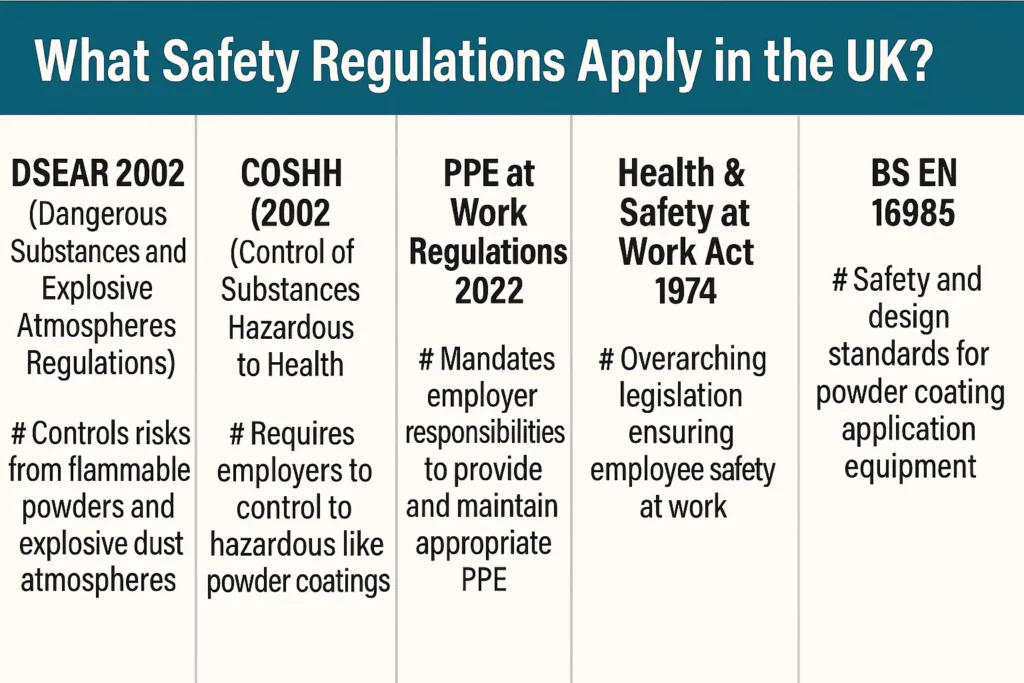
Safety Regulations for Powder Coating in The UK
What Are the Best Practices for Training and Safety Monitoring?
Workplace culture is just as critical as equipment and infrastructure. Operators must be properly trained to understand and apply safety protocols.
Key Training Practices
- Conduct induction training covering powder handling, PPE, emergency exits, and fire suppression systems.
- Offer refresher training every 6 to 12 months.
- Include safety checks and hazard recognition in daily routines.
- Ensure new employees shadow experienced operators before unsupervised work.
Safety Monitoring and Record-Keeping
- Carry out weekly checks of filters, grounding systems, and fire suppression devices.
- Run emergency drills quarterly and maintain incident logs.
- Review and update risk assessments annually or when equipment changes occur.
- Keep records of all inspections, training sessions, and maintenance.