Table of Contents
- 1. How does a powder coating gun work?
- 2. How does a corona charging powder coating gun work?
- 3. How does a tribo charging powder coating gun work?
- 4. How do corona and tribo powder coating guns compare?
- 5. Which powder coating gun fits your application best?
- 6. How to optimise the application with each powder coating gun type?
How does a powder coating gun work?
A powder coating gun applies dry powder to a grounded object using either electrostatic or friction charging. It ensures efficient powder transfer and creates a uniform finish before curing. This step links the powder application system to the spray booth and oven.
Role in the powder application process
A powder coating gun:
- Charges powder particles using one of two main methods:
- Corona charging: uses high-voltage electrostatic charging.
- Tribo charging: generates friction to build a static charge.
- Sprays the charged powder onto a grounded object. This electrostatic attraction holds the particles in place until heat curing.
- Improves coating uniformity, even on complex surfaces.
The wraparound effect helps powder reach hidden or recessed areas, though deep cavities can show the Faraday cage effect, where powder resists entering tight corners.
Integration with spray booth and curing oven
The gun works with:
- Spray booth: captures overspray and maintains airflow.
- Grounding systems: enhance conductivity, preventing charge buildup.
- Curing oven: melts and bonds the powder into a tough, even layer.
Summary of powder coating gun types
Gun Type | Charging Method | Strengths | Weaknesses |
Corona | Electrostatic | Strong wraparound, fast coverage | More overspray in corners |
Tribo | Friction-based | Low maintenance, fine detail | Lower charge on some powders |
Both types affect powder transfer efficiency and coating consistency. In comparing corona vs tribo powder coating guns, the choice depends on part geometry and required finish quality.
How does a corona charging powder coating gun work?
A corona charging powder coating gun uses electrostatic charging to give powder particles a negative charge. It does this by passing the powder through a high-voltage external electrode. The charged particles are drawn to grounded surfaces by electrostatic attraction.
Process and charging mechanism
The gun creates an electric field at the nozzle using a voltage of up to 100 kV. As powder flows past the electrode, it picks up a negative charge. This is the key mechanism in electrostatic powder application. The charged powder sticks to the part, provided proper grounding and conductivity are maintained.
This method delivers a high powder transfer efficiency, meaning most of the powder sticks to the part instead of falling away.
Benefits of corona charging
Corona charging is widely used across various industries. Its main advantages are:
- Strong wraparound effect, helping powder coat rounded or hidden surfaces
- Fast coverage on large or flat parts
- Broad compatibility with many powder types
- Smooth coating uniformity when applied correctly
Limitations of corona guns
The technology does face challenges:
- Faraday cage effect limits penetration into deep corners
- Back ionisation can occur if the charge becomes too strong, affecting the finish
- May require more care when coating thin edges or tight recesses
In the corona vs tribo powder coating gun comparison, corona suits flat or open surfaces, while tribo works better for complex shapes with deep cavities.
How does a tribo charging powder coating gun work?
A tribo powder coating gun uses friction charging to charge powder particles. Inside the gun, powder rubs against a non-conductive tube, like PTFE, which creates a positive electrostatic charge. This charge pulls the powder towards the grounded part.
How friction creates charge in tribo coating
In a tribo gun:
- The powder flows through a Teflon-coated channel
- Friction strips electrons from the powder, making particles positively charged
- These particles stick to the grounded object using electrostatic powder application
This approach avoids using high-voltage electrodes, making the gun design simpler and safer.
Benefits of tribo powder coating guns
Tribo guns provide key advantages:
- Smooth coating uniformity on thin or flat parts
- Effective in deep recesses, edges, or corners due to no Faraday cage effect
- No back ionisation, so finish stays clean without texture issues
- Good for recoating and multi-layer builds
- Safer to handle and easier to maintain
Tribo technology is often preferred when coating parts with complex shapes.
Limitations of tribo systems
There are also some trade-offs:
- Works best only with specific powders designed for tribo systems
- Charging efficiency drops with humidity or inconsistent particle size
- Lower powder transfer efficiency compared to corona guns
- Slower output means more guns may be needed on high-speed lines
In the corona vs tribo powder coating gun comparison, tribo performs better in hard-to-reach areas, while corona is faster on open parts.
How do corona and tribo powder coating guns compare?
Corona and tribo powder coating guns use different charging methods, and each offers unique strengths depending on the coating task. Both rely on electrostatic powder application to stick powder to grounded parts, but the charging principles and results vary.
Corona guns use electrostatic charging with high-voltage electrodes to create a strong wraparound effect, making them ideal for flat or large surfaces. However, they struggle with the Faraday cage effect in corners and recesses. These guns work with almost all powder types and offer flexible settings, but they require more upkeep and careful handling.
Tribo guns use friction charging. They work by rubbing powder against Teflon-lined paths, which generates a positive charge. This method avoids external electric fields, making tribo guns better for internal surfaces and fine parts. The result is smoother coating uniformity, with fewer issues in tight areas. However, tribo guns need powder-specific materials and have lower powder transfer efficiency.
Feature Comparison Table
Feature | Corona Gun | Tribo Gun |
Charging Method | Electrostatic (ionisation) | Triboelectric (friction) |
Wraparound Effect | Strong | Moderate |
Faraday Cage Effect | Higher risk | Less risk |
Powder Compatibility | Universal | Powder-specific |
Maintenance | Moderate | Lower |
Finish Smoothness | Moderate to high | Very high |

Corona and Tribo Powder Coating Guns
Which powder coating gun fits your application best?
The right powder coating gun depends on four core factors: part geometry, powder material, finish requirements, and operator experience. Matching these with the right gun ensures better powder transfer efficiency, coating uniformity, and a smoother workflow.
How to match gun type with coating needs
Tribo and corona guns are the two main types of powder coating guns. Each works best under different conditions.
Factor | Tribo Gun (Friction Charging) | Corona Gun (Electrostatic Charging) |
Part Geometry | Best for recesses, sharp corners, and deep cavities | Better for open, flat, or rounded surfaces |
Powder Type Compatibility | Needs tribo-compatible powders | Works with most powders |
Coating Uniformity | Excellent on detailed parts, no Faraday cage effect | High film build may struggle in tight areas |
Finish Quality | Smooth, even layers, minimal orange peel | Good on flat surfaces, can show texture in high-voltage areas |
Powder Transfer Efficiency | Moderate to high, varies by powder and airflow | High with proper grounding and conductivity |
Operator Skill Level | Easier to use for beginners | Requires control to avoid back ionisation |
Practical tip
If you need precision on complex shapes, tribo gives you better control. For large flat panels, corona offers faster coverage and a better wraparound effect. In a corona vs tribo powder coating gun decision, choose based on your part shape and powder type.
How to optimise the application with each powder coating gun type?
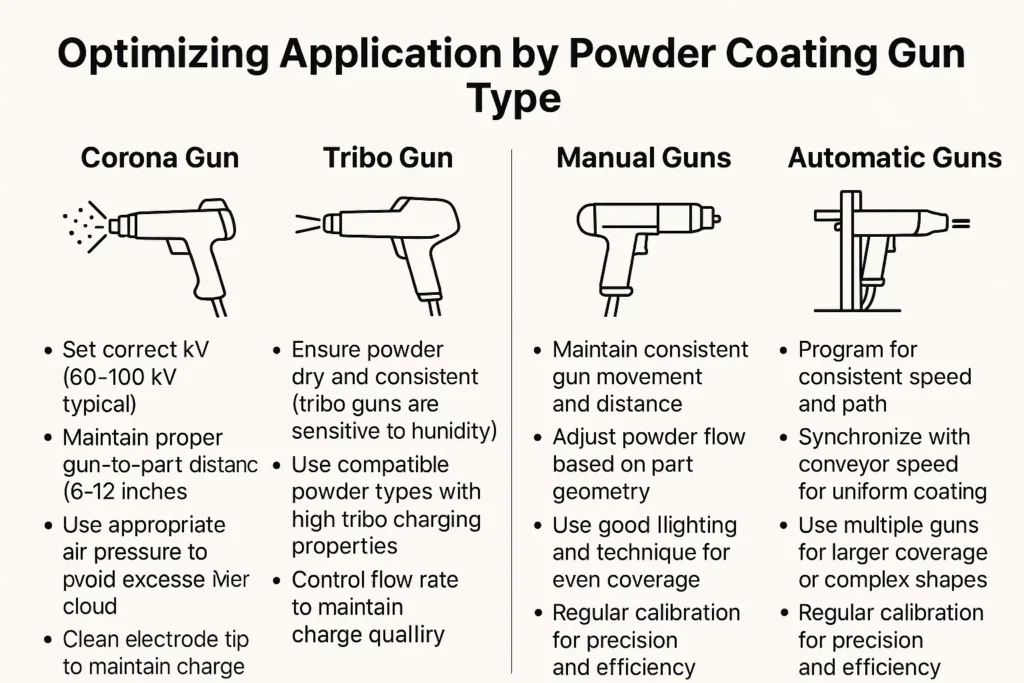
Using powder coating guns correctly improves coating uniformity and powder transfer efficiency. Both corona and tribo guns need precise control of grounding and conductivity, spray distance, and settings. Small adjustments help avoid common problems like back ionisation or the Faraday cage effect.
Key tips for application success
Factor | Corona Gun (Electrostatic Charging) | Tribo Gun (Friction Charging) |
Grounding & Conductivity | Must be strong to maintain a consistent charge and reduce overspray | Still essential, but less risk of electric discharge |
Gun Distance | 15–25 cm from surface to balance wraparound and film build | Closer range often preferred due to lower charge strength |
Voltage Settings | Use 60–90 kV, depending on geometry; lower for deep corners | No voltage control needed, relies on the material and airflow |
Powder Type | Works with most powders | Needs tribo-compatible, non-fusible powder particles |
Defect Prevention | Lower voltage to avoid back ionisation and orange peel | Keep airflow steady to prevent uneven buildup |
Faraday Cage Effect | Use auxiliary nozzles or pulse mode to push powder into recesses | Rarely occurs; tribo excels in tight corners |
In corona vs tribo powder coating gun setups, proper grounding makes the biggest difference. For corona guns, unstable grounding leads to low transfer efficiency and surface defects. For tribo systems, airflow and material quality are more critical.
Each gun type suits different applications. Adjust your setup accordingly to improve overall electrostatic powder application performance.
Powder Coating Gun Types