Table of Contents
- 1. What Is the RAL Colour System?
- 2. How Are RAL Colour Codes Structured and What Do the Digits Represent?
- 3. Which RAL Colours Are Most Commonly Used in Powder Coating Applications?
- 4. How to Choose RAL Colours for Powder Coating?
- 5. What Are the Alternatives to RAL Colours in Powder Coating and When Are Custom Colours Used?
- 6. How Can Colour Consistency be Maintained Throughout the Powder Coating Process?
What Is the RAL Colour System?
The RAL colour system is a standardised European system for colour identification, classification, and communication. Developed in Germany in 1927 by the Reichs-Ausschuss für Lieferbedingungen, it enables consistent colour reproduction across industries. It assigns each shade a unique four-digit RAL code, ensuring universal clarity in colour specification.
Each RAL code follows a structure where:
- The first digit indicates the colour group (e.g. 1 for yellow, 9 for black or white).
- The remaining three digits represent a sequence within that group.
RAL colours are used extensively in:
- Powder coatings
- Paints
- Plastics
- Architecture
- Product design
The RAL Classic collection includes 216 standardised colours. Other ranges include:
- RAL DESIGN system plus: 1,825 finely tuned shades for design.
- RAL EFFECT: 490 shades with metallic finishes for industrial applications.
Benefits of Powder Coating:
- Ensures colour accuracy across suppliers and applications.
- Facilitates precise matching via digital or physical swatches.
- Reduces ambiguity in communication between manufacturers and clients.
- Saves time in selection through easy-access RAL charts.
How Are RAL Colour Codes Structured and What Do the Digits Represent?
RAL colour codes are structured identifiers that standardise colour naming and ensure precise communication across industries. Each code comprises four digits preceded by the prefix “RAL”, such as RAL 9005 for Jet Black. This system enables manufacturers, designers, and suppliers to specify exact shades with zero ambiguity.
Code Structure and Colour Families
The first digit in a RAL code indicates the colour family:
- 1xxx – Yellow tones (e.g. RAL 1023 Traffic Yellow)
- 2xxx – Orange tones (e.g. RAL 2004 Pure Orange)
- 3xxx – Red tones (e.g. RAL 3003 Ruby Red)
- 4xxx – Violet tones
- 5xxx – Blue tones
- 6xxx – Green tones
- 7xxx – Grey tones
- 8xxx – Brown tones
- 9xxx – White and black tones
The remaining three digits are allocated sequentially to complete the full RAL identifier.
Standard Collections
The most used system is RAL Classic, consisting of 213 standardised colours. Examples include:
- RAL 9010 – Pure White
- RAL 7035 – Light Grey
- RAL 1003 – Signal Yellow
Other RAL systems include:
- RAL Design system plus (1,825 colours)
- RAL Effect (490 shades with metallic options)
Understanding the structure of RAL codes helps interpret colour specifications quickly.
Which RAL Colours Are Most Commonly Used in Powder Coating Applications?
Certain RAL colours are consistently preferred for powder coating due to their versatility, durability, and aesthetic appeal. These colours suit a wide range of industrial, architectural, and consumer applications. They are especially valued for their standardised consistency across different suppliers and production runs.
Frequently Used RAL Shades
- RAL 9005 (Jet Black): Deep black with high contrast, ideal for modern, industrial, and exterior metalwork.
- RAL 7035 (Light Grey): Neutral grey commonly used in machinery and enclosures.
- RAL 9003 (Signal White): Bright white that enhances visibility and cleanliness.
- RAL 9016 (Traffic White): Soft white, popular in architectural and interior coatings.
- RAL 3020 (Traffic Red): Bold, high-visibility red used in signage and safety equipment.
- RAL 5015 (Sky Blue): Calm, bright blue is frequently applied in commercial and public spaces.
- RAL 7015 (Slate Grey): Warm grey with a subtle tone, suited for window frames and façade elements.

RAL Powder Coating Colours and Their Uses
How to Choose RAL Colours for Powder Coating?
Selecting the right RAL colour for powder coating depends on function, environment, aesthetics, and material compatibility. The goal is to ensure that the chosen shade not only looks good but also performs well under the intended conditions.
Key Factors to Consider
- Purpose & Environment: Outdoor items benefit from colours that either blend with surroundings (e.g. RAL 6005 Moss Green) or enhance visibility (e.g. RAL 3024 Luminous Red). Indoor choices often focus on aesthetics, such as RAL 9010 for a clean look.
- Design Objectives: Lighter colours like RAL 9016 Traffic White create a fresh, modern feel. Darker tones like RAL 7016 Anthracite Grey offer a more industrial or formal appearance.
- Safety & Functionality: High-visibility tones like RAL 1026 Luminous Yellow are ideal for warning signs and safety applications.
- Colour Harmony: Complement or contrast with other materials or components, such as frames, fixtures, or surroundings.
- Trends vs. Timelessness: Balance current colour trends with long-term relevance by considering classics like RAL 7035 Light Grey.
What Are the Alternatives to RAL Colours in Powder Coating and When Are Custom Colours Used?
While RAL colours provide a consistent standard for powder coating, they are not the only option. Custom colours and RAL alternatives offer broader creative freedom, allowing designers and manufacturers to meet specific visual or branding goals.
Custom Powder Coating Colours
Powder coating can be formulated to match nearly any shade, including corporate colours and bespoke palettes. This enables greater flexibility in design and helps maintain brand consistency across materials and finishes.
Although custom options expand design possibilities, they often involve:
- Higher costs
- Minimum order quantities
- Longer lead times
RAL Alternatives
Other colour systems like Pantone or NCS (Natural Colour System) are also used, especially in industries such as graphic design or signage. Unlike RAL, these systems focus on visual communication and print reproduction.
Special Finishes and Effects
RAL and custom shades can be enhanced with:
- Glossy
- Matte
- Metallic
- Textured finishes
These options affect both the appearance and surface performance of the powder coating, contributing to aesthetics and functionality. Understanding these alternatives ensures better alignment between design intent, application requirements, and colour fidelity.
How Can Colour Consistency be Maintained Throughout the Powder Coating Process?
Colour consistency in powder coating is critical for quality, appearance, and long-term performance. Variations in application or environment can lead to colour shifts, uneven finishes, or fading. Maintaining uniform results requires attention to materials, conditions, and maintenance practices.
Influencing Factors
- Surface Preparation: Proper pre-treatment ensures even adhesion. Contaminants, oils, or oxidation can cause patchy results or discolouration.
- Application Control: Consistent spray settings, powder flow, and spray distance are essential. Variations can affect both colour depth and gloss levels.
- Curing Accuracy: Curing in ovens at 110–250 °C, depending on substrate and powder type, affects colour development. Undercuring can dull colours; overcuring may yellow lighter shades.
- Environmental Protection: UV exposure can degrade pigments, especially in reds, blues, and bright tones. Shielding or using UV-resistant powders extends finish life.
- Routine Cleaning: Weekly or bi-weekly cleaning with mild soap and filtered water prevents dirt build-up and environmental damage.
- Storage Conditions: Store coated items away from moisture, chemicals, and direct sunlight to preserve colour.
Quality Assurance Tools
- Use spectrophotometers to measure colour and gloss deviation.
- Match batches with RAL codes and limit pigment variations for precision.
Consistent outcomes rely on disciplined procedures and environmental awareness.
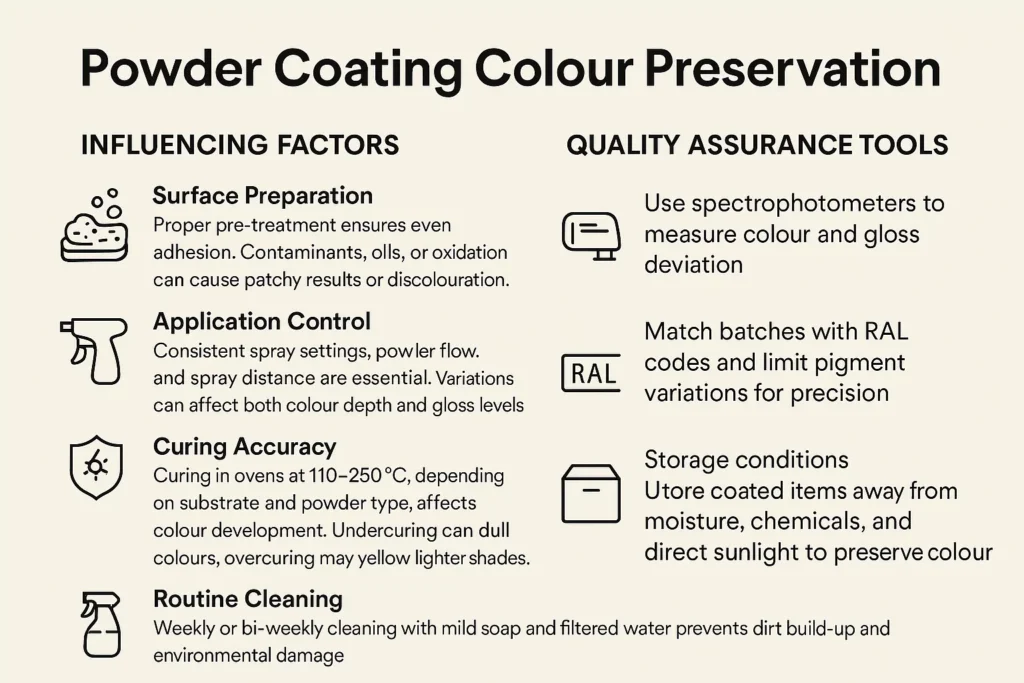
Maintaining Uniform Colour During Powder Coating