Table of Contents
- 1. What Makes Powder Coatings Food-Safe?
- 2. What Regulations Control the Use of Food-Safe Powder Coatings?
- 3. What Materials Are Used in Food-Safe Powder Coatings?
- 4. Where Are Food-Safe Powder Coatings Commonly Applied?
- 5. What Challenges and Risks Exist with Food-Safe Powder Coatings?
- 6. How Should Food-Safe Powder Coatings Be Maintained and Inspected?
What Makes Powder Coatings Food-Safe?
Powder coatings are widely recognised as food-safe when formulated and applied correctly. Their suitability for food contact surfaces stems from the use of specific resin systems and additives that meet strict regulatory standards, such as those set by the FDA and EU. These coatings are typically free from solvents and volatile organic compounds (VOCs), reducing the risk of contamination during application and use.
The non-toxic nature of approved powder coatings ensures they do not leach harmful substances into food, even under varying temperatures and conditions. Many food-safe formulations incorporate epoxy, polyester, or hybrid resins, offering strong chemical resistance, durability, and stability. This helps prevent chipping, flaking, or degradation, which could otherwise pose contamination risks.
An essential attribute is their smooth, non-porous surface, which limits the accumulation of bacteria, mould, and other pathogens. Some variants also include antimicrobial agents that actively inhibit microbial growth, further enhancing food safety. Additionally, powder coatings resist staining and odours, maintaining hygienic conditions essential for food processing, packaging, and storage equipment.
What Regulations Control the Use of Food-Safe Powder Coatings?
Food-safe powder coatings must meet strict regulatory standards to ensure they do not compromise food safety. These regulations govern composition, application, and performance under food contact conditions.
In the European Union
- Governed primarily by EU Regulation 1935/2004, which ensures that materials do not:
- Release substances that could endanger human health.
- Alter the taste, smell, or composition of food.
- Manufacturers must maintain controlled production processes to prevent contamination.
- Some EU Member States may impose additional national requirements, including further testing or documentation.
- The European Council of the Paint, Printing Ink and Coatings Industry (CEPE) provides industry-specific guidelines and best practices for compliance.
In the United States
- Regulated by the Food and Drug Administration (FDA) under Title 21 CFR, which evaluates:
- Formulation ingredients.
- Migration limits of substances from coatings into food.
- Coating stability under varied temperatures and conditions.
- The National Sanitation Foundation (NSF) offers certifications for coatings used in food processing equipment, ensuring additional safety standards are met.
By complying with these international regulations, food-safe powder coatings remain non-toxic, chemically stable, and durable. This guarantees that food contact surfaces maintain hygiene, prevent contamination, and support long-term food safety.
What Materials Are Used in Food-Safe Powder Coatings?
The choice of powder coating material plays a critical role in ensuring food safety, durability, and compliance with regulations. The following table outlines the most common materials used for food applications:
Material | Key Properties | Common Food Applications |
PTFE (Polytetrafluoroethylene) | Excellent non-stick, heat resistance, chemical inertness | Baking trays, cooking utensils, conveyor belts |
FEP (Fluorinated Ethylene Propylene) | Flexible, high chemical resistance, easy processing | Flexible food equipment coatings, wiring insulators |
Polyesters | UV resistance, corrosion protection, durable surface | Food packaging machinery, external equipment, storage units |
Acrylics | High clarity, resistant to yellowing, smooth finish | Food display cases, clear food containers |
Epoxy-Polyester Hybrids | Chemical resistance, flexibility, strong adhesion | Interior equipment parts, shelves, food processors |
Polyvinyl Chloride (PVC) | FDA-approved, pliable, chemical stability | Food packaging, insulated equipment components |
These specialised coatings ensure that surfaces remain hygienic, non-toxic, and capable of withstanding the demands of food processing and storage environments.

Materials Commonly Used in Food-Safe Powder Coatings
Where Are Food-Safe Powder Coatings Commonly Applied?
Food-safe powder coatings are widely used across food production, preparation, packaging, and storage environments. Their chemical resistance, non-stick properties, and thermal stability make them ideal for maintaining hygiene, extending equipment life, and ensuring food quality.
Application Area | Component | Purpose & Benefit |
Food Processing Equipment | – Chemical vessels – Pipework – Agitators – Ductwork | Prevents food residue build-up; ensures smooth operation; protects against corrosion |
| – Conveyor belts and rollers | Non-stick surface reduces contamination risk and preserves food texture |
| – Moulds and dies | Improves product release; reduces waste and clean-up time |
Cooking & Baking Equipment | – Mixing bowls – Beaters – Dough hoppers | Non-stick coatings simplify cleaning and reduce product loss |
| – Baking trays and pans | PTFE coatings withstand high heat and offer easy food release |
| – Food trays and utensils | Durable, hygienic surfaces for handling and serving food |
Packaging & Storage | – Packaging machines | PFA coatings reduce sticking and maintain packaged food integrity |
| – Storage bins, containers, baskets | Safe surfaces prevent contamination and support long-term food preservation |
These coatings ensure compliance with food safety regulations while improving operational efficiency and product quality across all stages of food handling.
What Challenges and Risks Exist with Food-Safe Powder Coatings?
While food-safe powder coatings offer numerous advantages, several technical and operational challenges must be carefully managed to maintain safety, durability, and compliance.
Challenge / Consideration | Description | Impact |
Adhesion | Poor surface preparation can result in weak adhesion, leading to chipping and peeling. | Potential contamination and coating failure. |
Uniform Thickness | Achieving consistent coating on complex geometries is difficult. | Thin areas may compromise protection; thick spots may crack. |
Migration | Careful formulation is needed to prevent harmful substances migrating into food. | Health risks and regulatory non-compliance. |
Regulatory Compliance | Coatings must meet strict food safety regulations and proper labelling standards. | Essential for consumer safety and market approval. |
Specialised Equipment | Application requires controlled environments with spray booths and curing ovens. | Increases setup and operational costs. |
Contamination | Dust, oil, or foreign particles can enter during the coating process. | Defects, reduced performance, and food safety concerns. |
Surface Preparation | Thorough cleaning and preparation are essential for optimal adhesion. | Directly affects coating integrity and lifespan. |
Outgassing | Trapped gases can create pinholes during curing. | Visual defects and weakened barrier properties. |
UV Resistance | Some coatings degrade under UV exposure, especially in outdoor settings. | Loss of durability and appearance. |
Cleaning Sensitivity | Harsh cleaning agents may damage the coating surface. | Premature wear, staining, or structural breakdown. |
Addressing these factors ensures food-safe coatings remain effective, reliable, and compliant throughout their service life.
How Should Food-Safe Powder Coatings Be Maintained and Inspected?
Proper maintenance and regular inspection are essential for preserving the performance, hygiene, and safety of food-safe powder coatings. Following structured care routines helps extend the coating’s service life and ensures compliance with food safety standards.
Activity | Guidelines | Purpose & Benefit |
Cleaning | – Use mild soap and warm, filtered water. – Apply with soft cloth or sponge. – Avoid steel wool, abrasive pads, or harsh chemicals. – Always test unfamiliar cleaning products on a hidden area first. – Wear gloves to prevent fingerprints and oil transfer. | Maintains surface integrity, prevents damage, and supports hygiene. |
Visual Inspection | – Regularly check for scratches, chips, peeling, or discolouration. – Pay extra attention to high-contact and high-wear areas. | Early detection of damage prevents contamination and coating failure. |
Adhesion Testing | – Periodically assess bond strength between coating and substrate. – Focus on areas subject to stress or environmental exposure. | Ensures continued protection and prevents flaking or delamination. |
Thickness Measurement | – Monitor coating thickness to confirm it remains within specified limits. | Maintains protective barrier and performance consistency. |
Impact Resistance | – Test periodically for resilience against mechanical shocks or operational stresses. | Confirms durability and coating stability under normal use. |
Quality Control Checks | – Verify parameters such as hardness, gloss, and adhesion meet required standards. | Maintains regulatory compliance and long-term performance. |
Professional Consultation | – Seek expert evaluation for significant damage or complex repairs. | Ensures proper remediation and prevents safety issues. |
Consistent care and proactive inspections ensure that food-safe powder coatings continue to perform effectively, preserving hygiene and structural integrity over time.
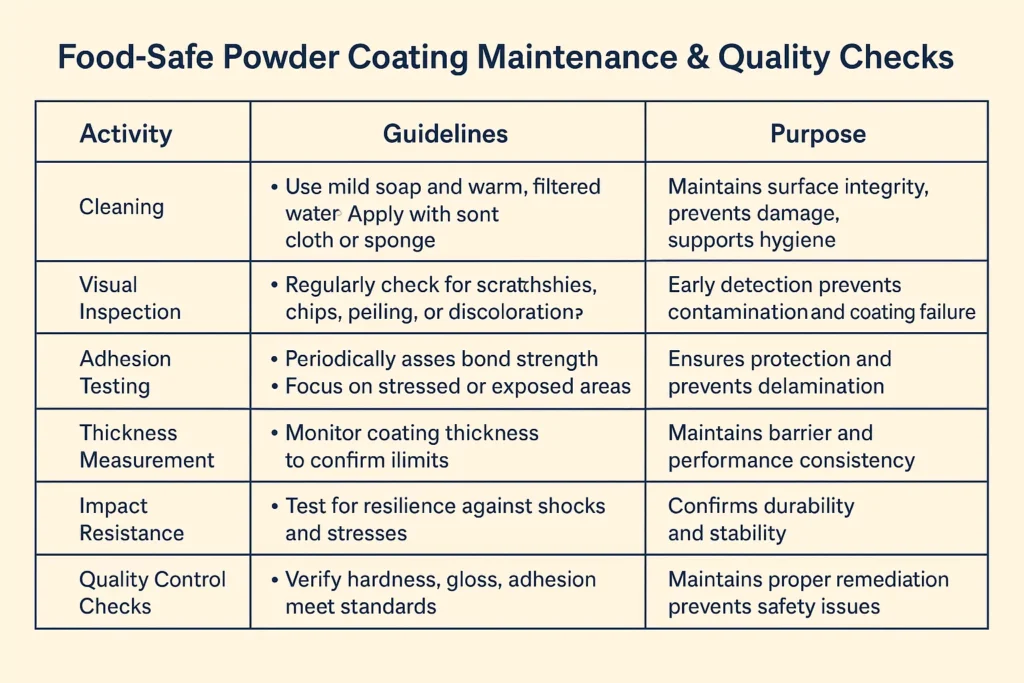
Maintaining and Inspecting Food-Safe Powder Coatings